
Seville is one of the jewels of Spain. With its mudéjar past, it is a city where you can find many buildings of Arabic-style architecture right next to Catholic monuments. It is also a place with an infinite number of restaurants where you will be able to try all the best dishes of Spanish cuisine. Let’s explore more in details this wonderful Andalusian city!
OUR ITINERARY
- DAY 1 – Palacio de la Condesa de Lebrija + Palacio de las Dueñas
- DAY 2 – Alcázar de Sevilla + Parque de María Luisa
- DAY 3 – Triana neighborhood + Museum of Popular Arts and Traditions
- DAY 4 – Casa Fabiola – Art collection Mariano Bellver + Archivo de Indias + Museum of Fine Arts + Setas de Sevilla
- DAY 5 – Casa de Pilatos + Plaza de España
DAY 1: VISITING THE CITY’S PALACES
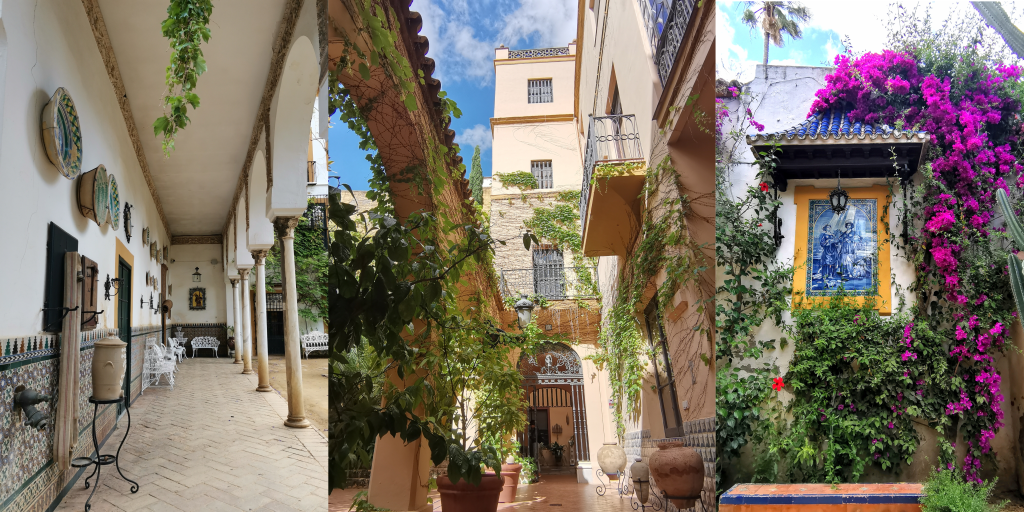
In this photo: Palacio de las Dueñas left and right, Palacio of the Countess of Lebrija at the center
My favorite activity in Seville has been visiting the city’s many palaces. Most of them have an architecture reminiscent of the mudéjar period with its ceramic tiles, its archs and stucco moldings. On our 1st day in Seville, we visited 2 of the most beautiful palaces which the city has to offer.
Morning at the Palace of the Countess of Lebrija
The visit to the Palace of the Countess of Lebrija will cost you 12€ per person. I recommend booking your visit in advance on the palace’s official website. Indeed, entrances are likely to be sold out if you try to buy them directly at the counter on the desired day of your visit. This comment is also valid for most of the monuments to visit in Seville.
This palace, as its name indicates, belonged to the Countess of Lebrija. She reformed entirely the house and furnished it with a wonderful collection of pieces from the entire world. You can see this collection by taking the guided visit of the 2nd floor of the building. The guided visit is given in Spanish and English.
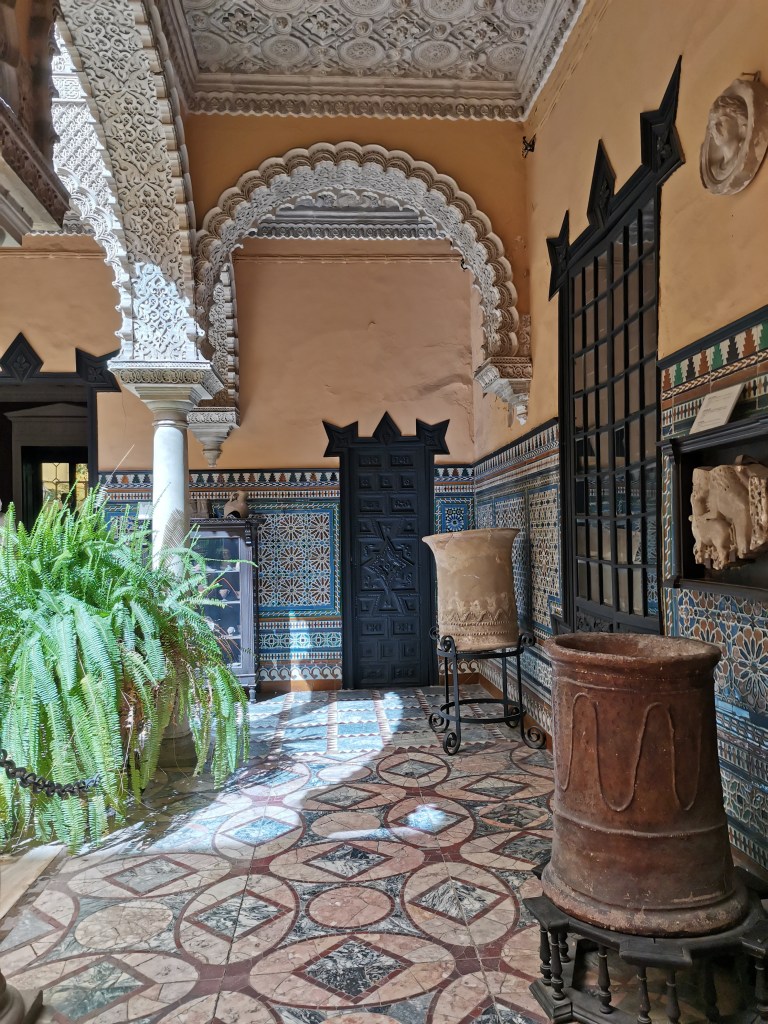
Meanwhile, on the bottom floor, you will find out about another passion of the countess: archaeology. As a result of this passion, the main patio and a few other rooms of the first floor are paved with Roman mosaics that she brought from archaeological sites such as Itálica (a Roman archaeological site located 10 km from Seville and that you may also visit). On the same floor, you will also encounter archaeological artifacts collected by the Countess in various display cases.
Not only was the Countess of Lebrija a collector but it is also worth mentioning that she had an excellent taste in decoration. The bottom part of the house counts many beautiful ceramic tiles. Most remarkable, although damaged by the passing of time, are the ones ornamenting the kitchen’s ceiling which represent Spain’s most notorious cities. On the house’s main patio, you will also marvel at the columns with stucco moldings reminiscent of the mudéjar period. These were made entirely at the demand of the Countess.

Finally, part of the bottom floor is dedicated to the Countess’ life. There, you will be given the chance to admire another talent of the Countess: painting. Several of the pieces that she realized are on display there.
Overall, the Palace of the Countess of Lebrija is a must-see monument in Seville. Make sure you book your visit so you do not miss out!
Afternoon at the Palace of las Dueñas
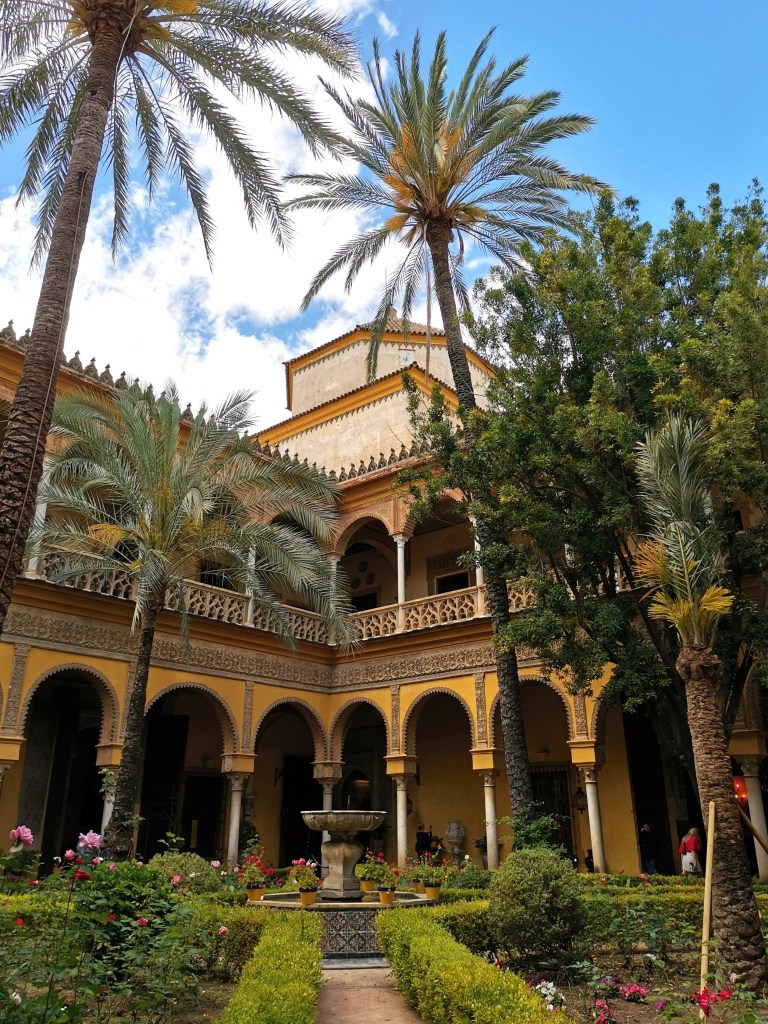
After a nice meal in the buzzing central neighborhood of the Cathedral of Seville, we headed to the Palace of las Dueñas. This palace is owned by the Alba family, one of the richest and most influent noble family in Spain. Some of the areas of the palace actually remain private as the family still lives there.
To understand the influence of the Alba family, let me leave you with one fun fact: the former Duchess of Alba, Cayetana Fitz-James Stuart, who died in 2014, used to be the person with the most noble titles in the world. She absolutely loved Seville and so made of the Palace of las Dueñas her main residence. During your visit there, you will actually see rooms decorated based on some of her passions: the Feria de Sevilla (main annual event of the city), the local traditional dance and the corridas.
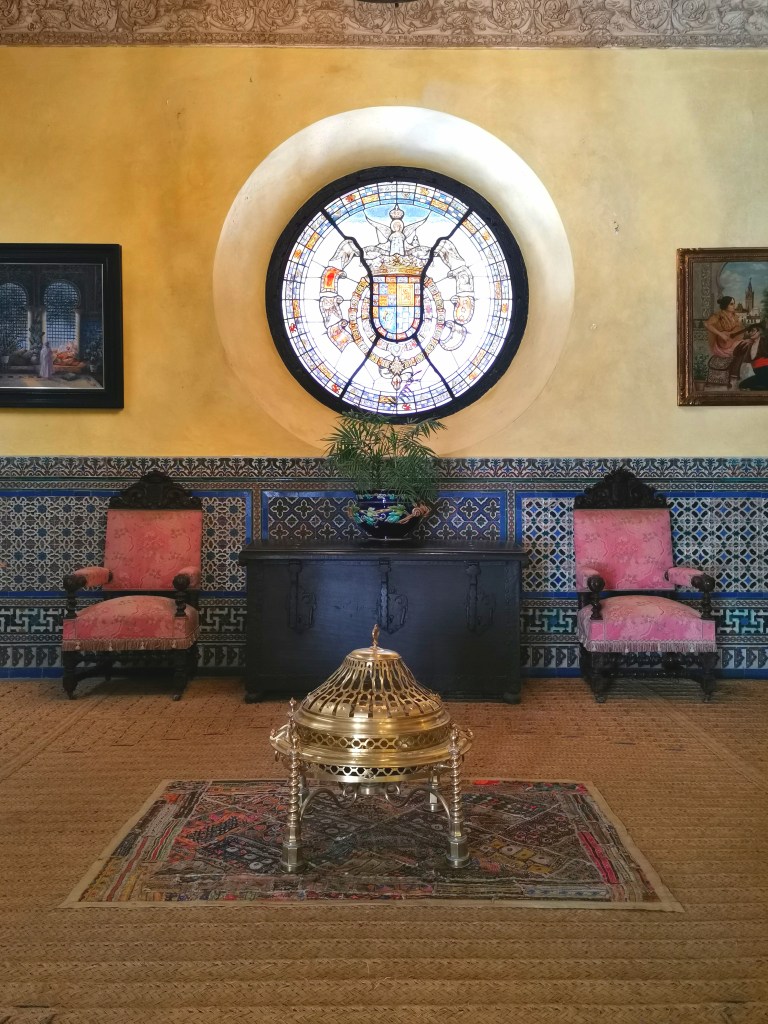
Let me share another fun fact about the Alba family that will also give you an idea of the family’s influence: Eugenia, the empress of France & wife of Napoleon III, originated from this family and actually lived in its palaces. If you ever get the chance to also visit their Madrid palace, called Palace of Liria, you will actually get to witness many objects of decoration with her initials on them.
Upon your arrival at the Palace of las Dueñas, you will be immediately struck by its beauty. If you come in spring, you will be met with the facade of the entrance building covered with flowers. Pursuing your visit, you will encounter wonderful gardens, beautiful patios and rooms decorated with great taste. The overall feeling after the visit is that of having seen a palace where every detail has been carefully designed without losing in the process the identity of the family living in the palace’s walls. Indeed, the rooms presenting the collection of posters from the Feria de Sevilla as well as the rooms filled with memorabilias of sevillanas and bullfighting let transpire the personality of the duchess who used to live there.
DAY 2: DIVING INTO THE HISTORY OF SEVILLE & STROLL IN A PARK
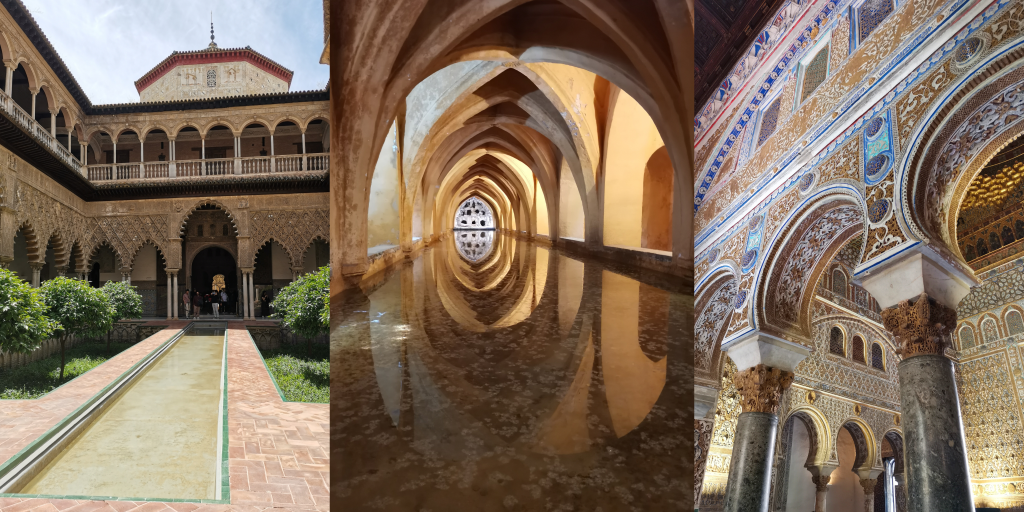
In this picture: Alcázar de Sevilla
For our 2nd day in Seville, we walked to the Alcázar, one of the most historically-rich monuments of the city. On our way there, we passed some beautiful streets and squares including Avenida de la Constitución (a large avenue bordered by beautiful buildings on both sides, including the Seville Town Hall) and Plaza del Cabildo (a round-shaped pretty square with antiquaries and souvenir shops). I recommend that you also check out these lovely places that show the architectural heritage of Seville.
Discovering the rich past of the Alcázar de Sevilla
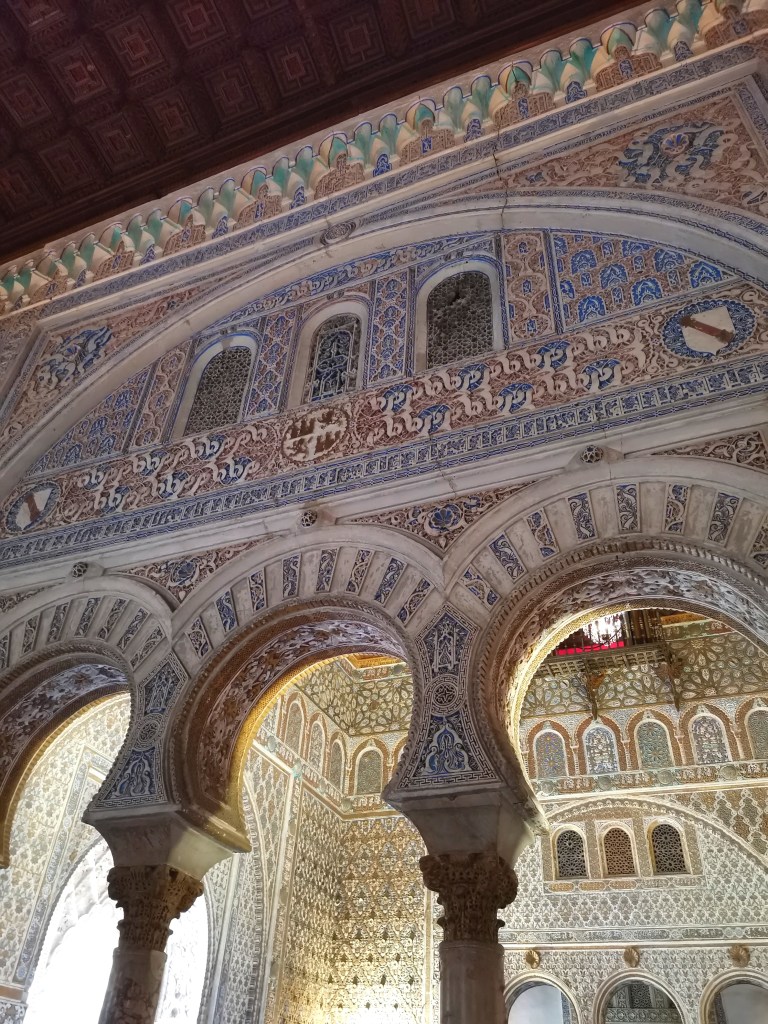
The Alcázar is a vast complex of buildings and luxurious gardens created over the course of time. Located on a former Roman site, most of the buildings we can see today date back from the Middle Ages and are from islamic and mudéjar styles. As the Alcázar also later became a royal residence for the Catholic kings, some parts are built in more traditional European architecture. The beauty of the Alcázar really lies in its ability to reunite in one place elements from all the different civilizations who came to live in Seville. It really demonstrates the rich history of the city. Up to this day, the Alcázar remains one of the official residences of the Royal Family of Spain.
The entrance to the Alcázar costs 14,5€ per adult. If you happen to have the European Youth Card (for citizens of the European Union below 30 years old), you can pay the reduced fare of 7€. If you wish to visit also the Royal Apartments within the Alcázar, your ticket for the visit of the Alcázar and the Royal Quarter will cost you a total of 20€ per person. Make sure to book in advance as tickets sell out fast. We booked our tickets a few days before the visit and the tickets to the Royal Apartments were already sold out. I also recommend booking your tickets for early afternoon. The Alcázar complex is vast and it will take you several hours to visit it all. Furthermore, there are not a lot of places to eat inside the complex.
Exploring the first public park of Seville
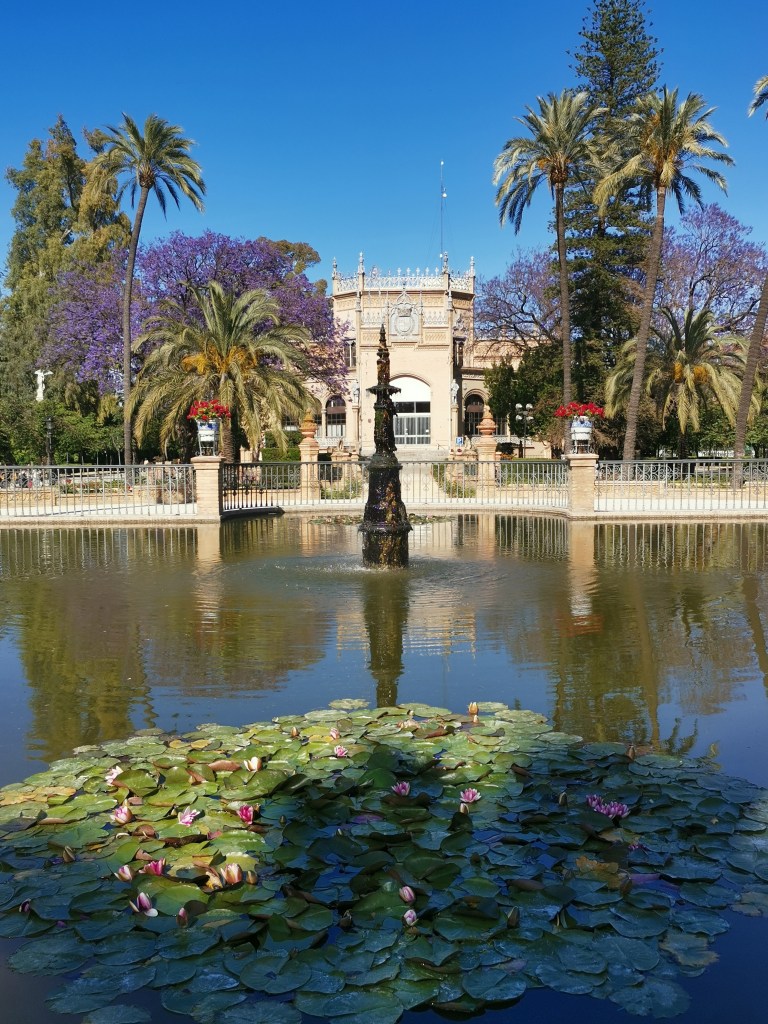
After our visit of the Alcázar, we headed to Parque María Luisa. This public park was the first to open in the city, providing its inhabitants with a vast green space. It is absolutely charming. You will see there fountains, a rose garden, a cascade, ponds and wonderful monuments dating back from the Ibero-American Exposition of 1929. Have a nice stroll in this park’s alleys to discover it all!
DAY 3: LEARNING MORE ABOUT THE TRADITIONAL HANDICRAFTS
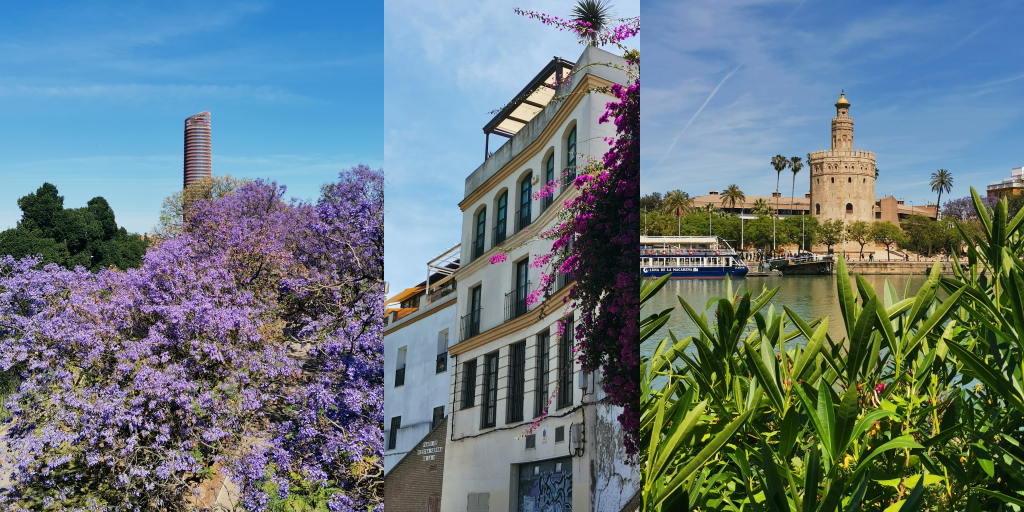
In this photo: Torre Sevilla on the left, Paseo de Nuestra Señora de la O at the center, Torre de Oro on the right.
During our first two days in Seville, we discovered much of the city’s history and architectural wonders. For our 3rd day in the city, we aspired to learn more about the traditional local crafts. Should you wish to bring back souvenirs from your trip to Seville, the itinerary for this day will bring you to the best places to buy them.
Walking the streets of Triana
Our morning started by a nice walk to reach the neighborhood of Triana. On our way, we crossed the Isabel II iron bridge. Get your camera ready on this bridge as you will get great views from it on the Alfonso XIII channel, on the Seville Tower (skyscraper designed by César Pelli) and on Calle Betis (known for its colorful façades).
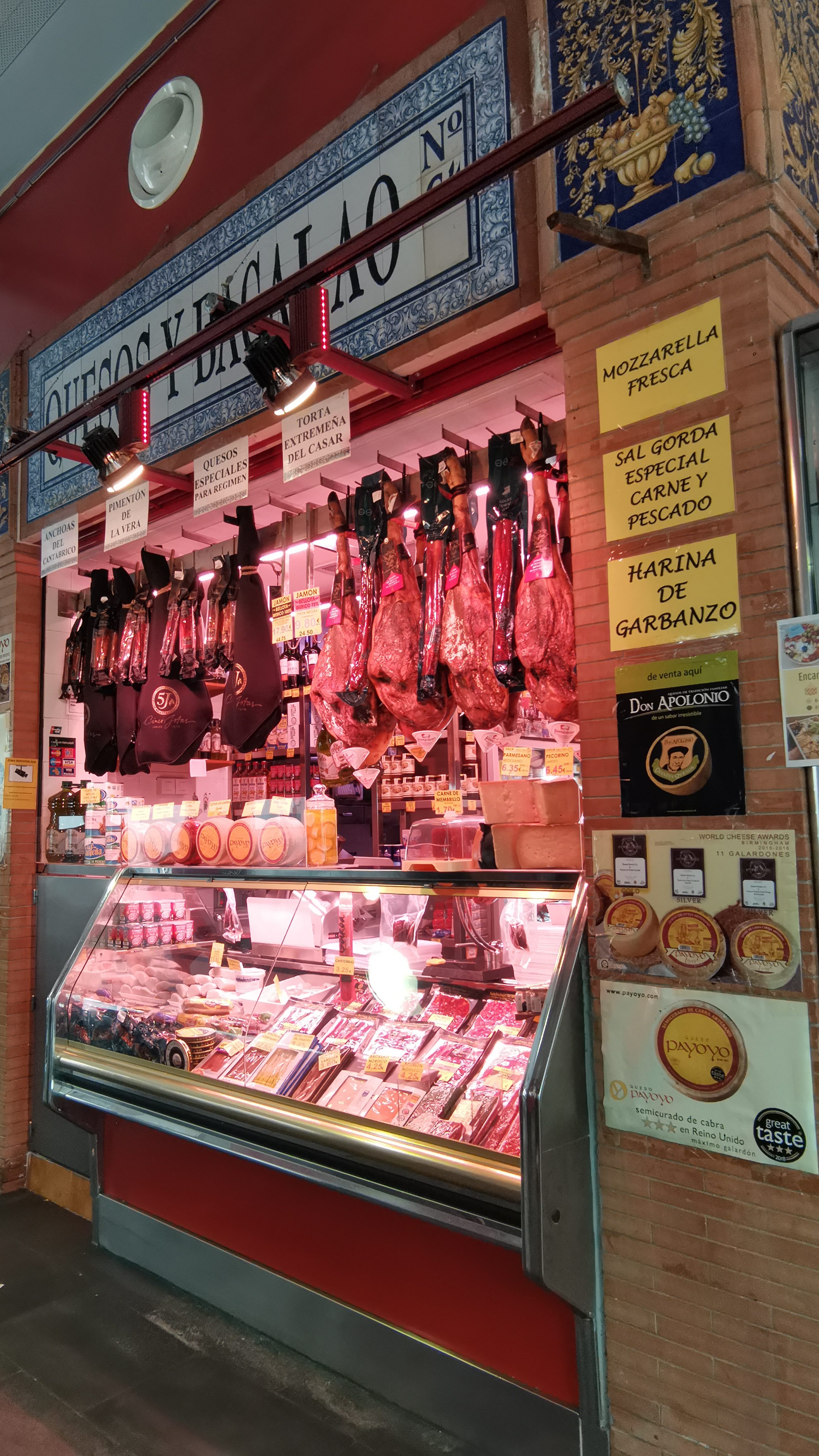
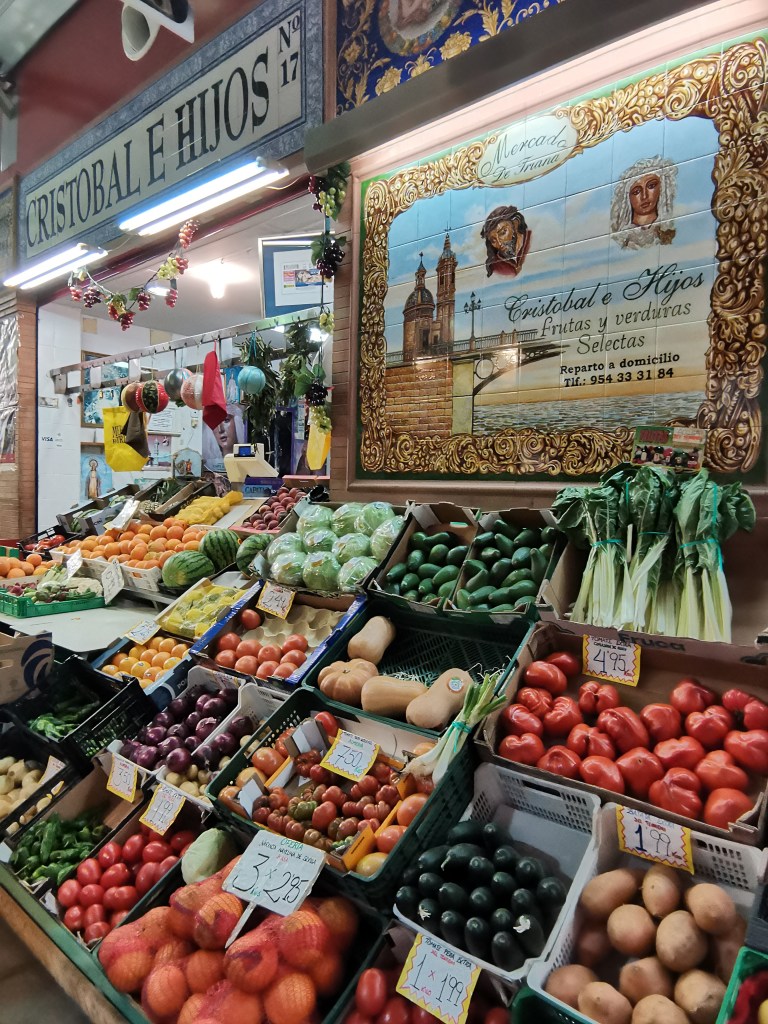
After crossing the bridge, continue straight ahead and you will find on your right the Triana Market. I highly recommend that you go visit it as this market is absolutely beautiful. Inside, the name of each shop is indicated by stunning ceramic tiles. You will also find all kinds of delicious local products there (fruits, vegetables, Iberian ham, cheese, fish,…).
Take a right after exiting the market, go down Calle San Jorge up to the crossing with Calle Callao. There, you will have arrived at the epicenter of ceramic productions in Seville. In Calle Callao and neighbouring streets, you will find many ceramic workshops with stores selling their creations. You will also witness many former ceramic workshops that now have been transformed into hotels and where only a plaque on the façade is left, letting us know of the past function of these buildings.
If you are looking to bring back pretty ceramic pieces from your trip to Seville, I highly recommend the shop called Ceramica Triana – https://maps.app.goo.gl/AaZf7MpKmpQyu3Ap6. In this store, you will find a wide variety of designs and types of objects made of ceramic: from dishes to bowls, without forgetting decorative plaques and tiles.
After having shopped for wonderful ceramic pieces in the many artisanal shops of Triana, go back in the direction of the channel. Make a stop on Plaza de Altozano to take a picture with the statue of the flamenco lady.
Following Plaza de Altozano to its end, you will get back to the bridge of Isabel II. However, instead of crossing the bridge, take the stairs next to it to go down onto Paseo de Nuestra Señora de la O. Have a nice stroll along the channel up to Torre Sevilla on this peaceful walkway. Once at Torre Sevilla, admire this modern tower which differentiates itself from the typical historical buildings of Seville. This skyscraper was designed by César Pelli, the same architect behind the Petronas Towers in Kuala Lumpur.
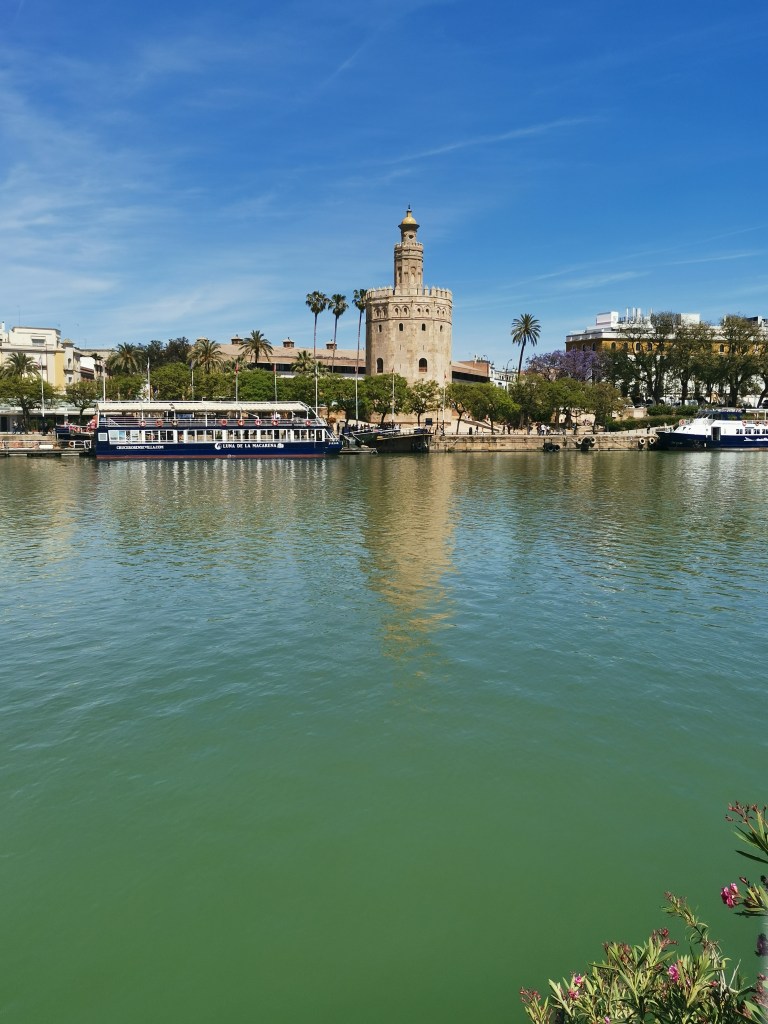
Having admired Torre Sevilla, you can now go back on your steps up to the Isabel II bridge. Go back up the stairs and continue your walk onto Calle Betis. You will see there many lively bars and restaurants along the channel. You will also have great views onto the Torre de Oro, one of the most famous historical monuments in Seville. Make your way up to San Telmo bridge. Crossing this bridge will mark the end of your stay in the neighborhood of Triana, so emblematic for its ceramic workshops.
After crossing the bridge, continue your promenade onto Paseo Alcalde Marqués del Contadero which will be on your left. You will be able to get a closer look of the Torre de Oro from there and you will get to see a reconstitution of the vessel Victoria, used during the very 1st round-the-world tour during the 16th century. This reconstituted vessel is home to a museum relating this historical event. Further up the alley, make sure to take a small detour to go see the entrance to the Plaza de Toros de la Real Maestranza which is the bullfighting arena of Seville.
Learning about local traditions beyond ceramic production
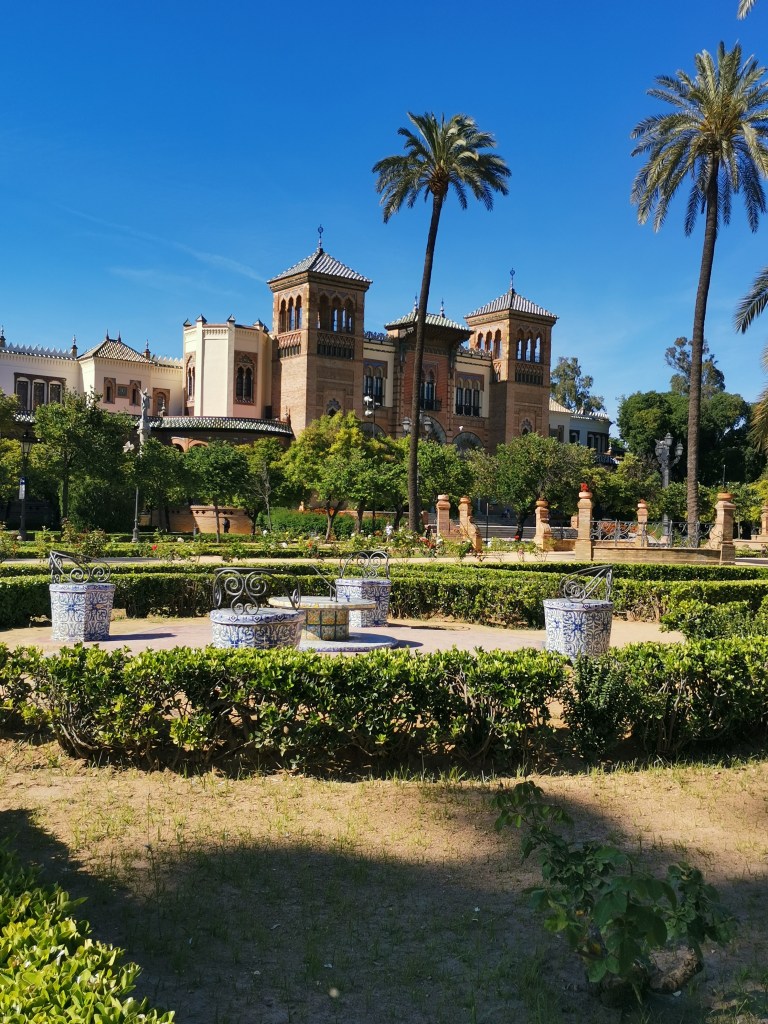
If you love discovering about the customs and traditions of the places you visit, you are going to really enjoy the next stop of the itinerary. Our afternoon plan on this day was to head to the very far edge of the Parque Maria Luisa to visit the Museum of Popular Art and Traditions. The entrance to this museum is free for citizens of the European Union and costs 1,5€ per person otherwise.
Inside, on the main floor, you will see an exhibit on what custom and traditions are and why they are important to perpetuate in a world that is becoming more and more globalised. Some of the customs from Andalusia are also displayed in the exhibit. Downstairs, you will be able to learn about all the traditional handicrafts from the region. Workshops of the different types of artisans are also recreated there. Additionally, you will get to learn about the local wines in this section of the museum. This museum is overall a great place to get to know a little bit more about local culture.
The museum itself is located inside a beautiful building of mudéjar architecture. Called the Mudéjar Pavillion, it was constructed for the 1929 Ibero-American Exhibition, a sort of Wolrd Exhibition. Most of the neighbouring buildings to the museum have also been erected for this event.
DAY 4: A MIX OF ART, HISTORY AND ARCHITECTURE
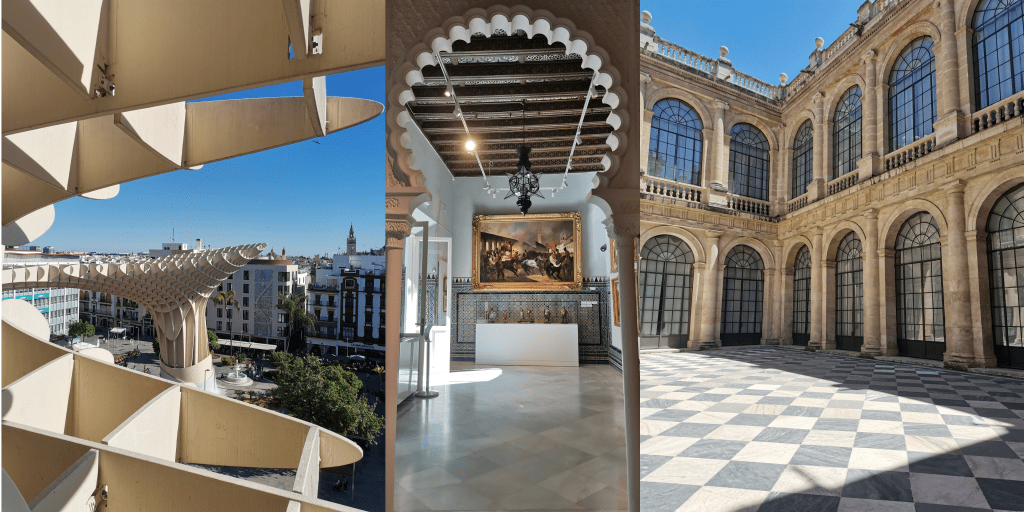
In this picture: Setas de Sevilla on the left, Casa Fabiola in the middle, Archivo de Indias on the right
For our 4th day, we visited a lot of interesting and very varied places within the city. We went from touring a private art collection to seeing the archives where are kept historical documents from the colonisation period. We then headed to a fine arts museum before ending the day at the famous Setas de Sevilla for a panoramic view of the city.
Starting the day with an artsy plan
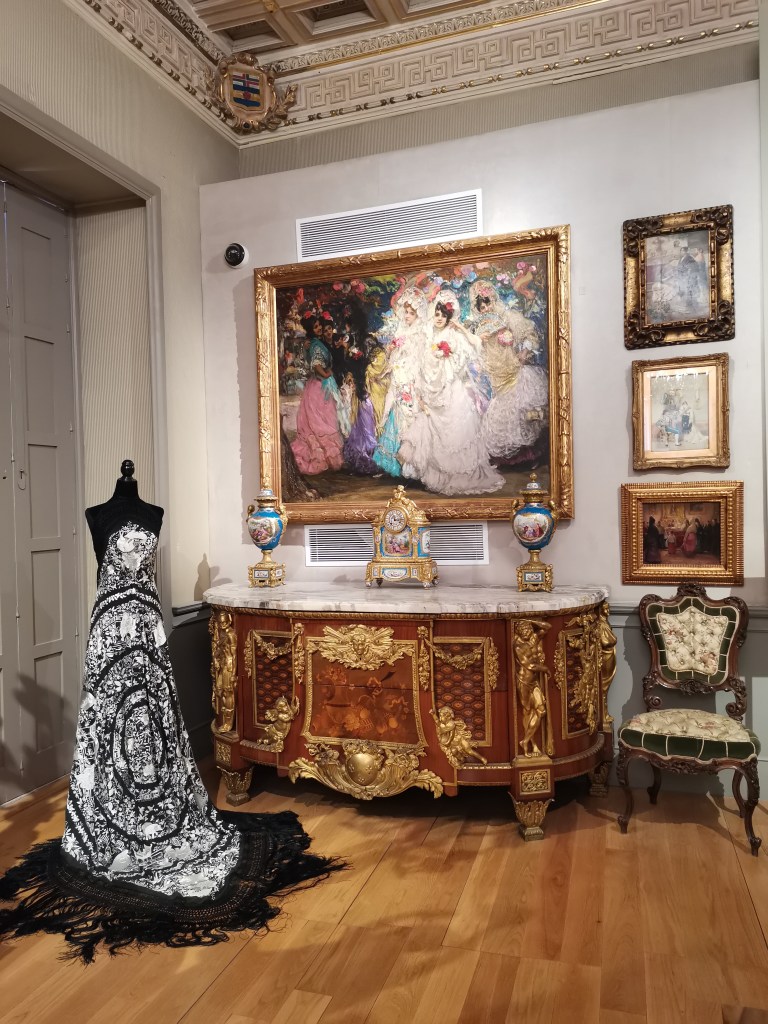
Our first stop of the day has been Casa Fabiola where you can see exhibited the Mariano Bellver private art collection. The entrance to Casa Fabiola will cost you 3€ per person.
The Mariano Bellver art collection is great. On the bottom floor, I particularly loved the paintings from the costumbrista movement. This artistic movement consisted in depicting traditional scenes from life in Seville. I also really enjoyed the room with typical embroidered silk shawls from Seville. The embroideries on some of them were very detailed.
On the 2nd floor, you will find some extremely realistic paintings from Spanish painters who had gone to Italy to be taught the most innovative techniques of the time before coming back to Spain. There is also a room with many pretty sculptures. Finally, you will get to admire the exquisite pieces of French furniture displayed in the rooms.
Followed by a history parenthesis
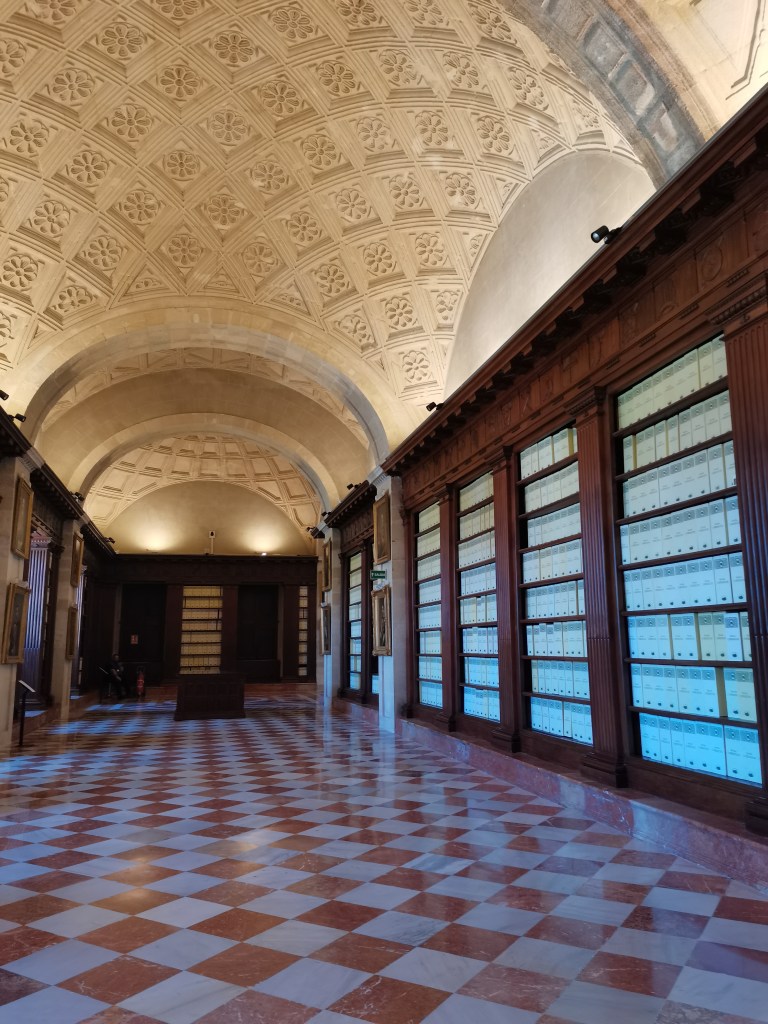
After a little bit of art, let’s dive into Spanish history. We headed for this to the Archivo General de Indias. Located right next to the Cathedral, the entrance to this building is free. Initially created for merchants, the use of the building then changed to become the home for the archives of all the documents on Spanish overseas territories dating from the 15th to the 19th centuries.
Among the documents stored there are pieces so impressive that they are inscribed in the Memory of the World Register of the UNESCO. This means that these documents have been so important in the history of humanity that it is considered essential that they never be forgotten. 4 of the documents exhibited at the Archivo General de Indias make the list:
- The Treaty of Tordesillas: In this 1494 treaty, a line of demarcation is decided between Spanish and Portuguese kingdoms.
- The Capitulations of Santa Fe: In these 1492 documents, you can find the conditions agreed to by Christopher Colombus with the Spanish kings and queens of the time for his expeditions that led to the discovery of America.
- The documents from the Keicho Mission: Documents from a Japanese mission to Europe in 1613. This diplomatic Japanese mission came to Spain to establish commercial ties. It also allowed two very different cultures to meet each other.
- The Vocabulary of Native Languages from the New World translated to Spanish: Lexicon of 35 American and Asian native languages translated into Spanish. This document dates back from the 18th century. Some of the languages in these documents have disappeared completely today, hence the historical importance of the document.
The Archivo General de Indias also holds many temporary exhibits linked to its archives. Currently (May-June 2024), the temporary exhibit displayed is centered on the literature from Peru during the period of colonization.
I still can’t believe how much you learn during your visit of the Archivo General de Indias if you take the chance to read all the signs there!
Back to the fine arts
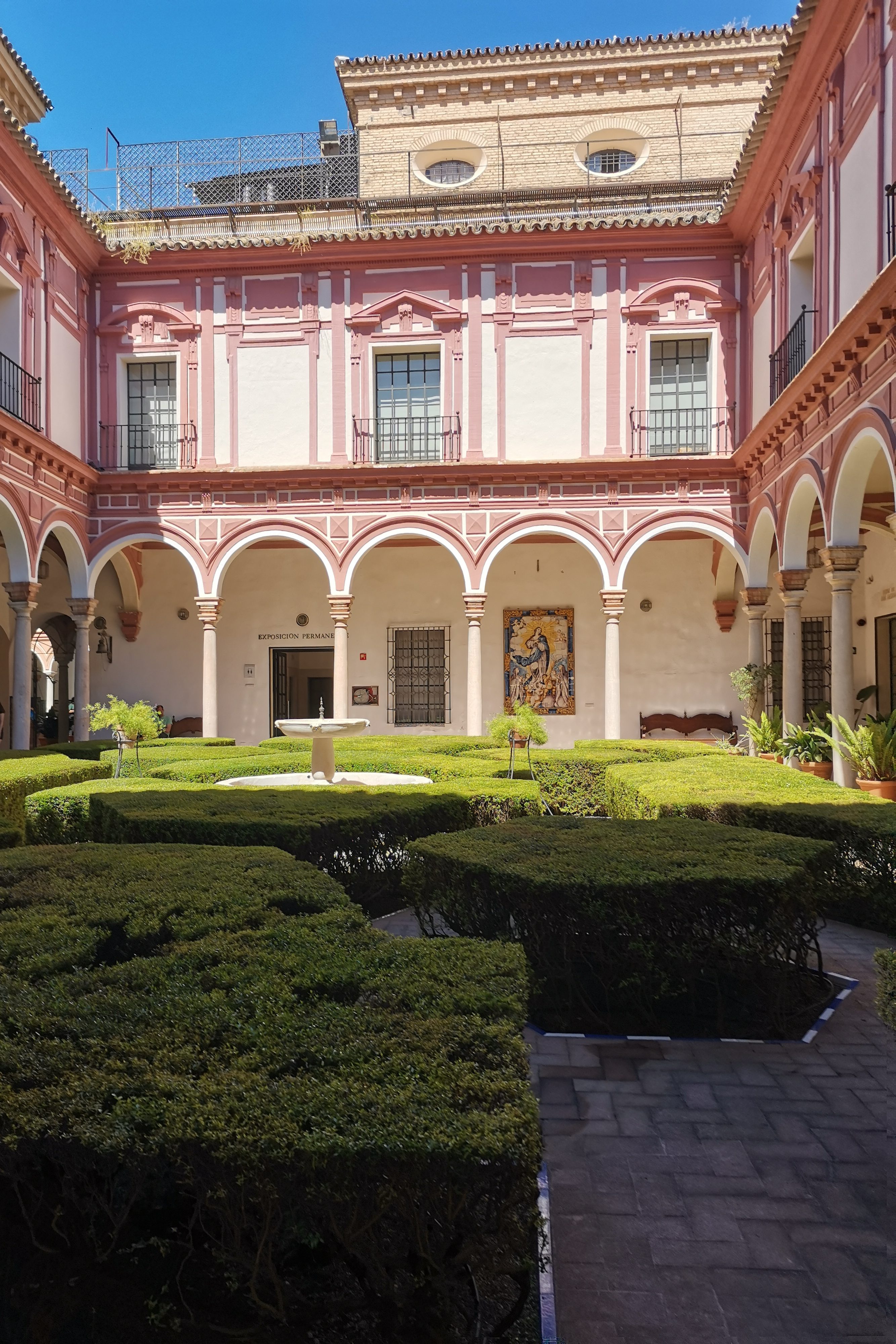
With lots of new historical facts in our heads, we continued our visit of Seville and returned back to the art world for our next stop: the Museum of Fine Arts. The entrance to this museum is free for citizens of the European Union and will cost you 1,5€ per person otherwise. There are QR codes all over the buildings allowing you to access the museum’s audio-guide. I recommend that you listen to it to learn more about the historical context of each art piece you will see in this museum.
On the bottom floor of the museum, you will see the oldest pieces from the museum, essentially religious art. If you are like me and not a great fan of religious art, this will probably not be your favorite section. However, you will surely love the art displayed on the first floor. There, you will find some costumbristas paintings depicting traditional scenes of life in Seville. You will also witness a series of 8 large paintings depicting an event organised in Seville to celebrate the coronation of Fernando VI in 1747.
Time for a panoramic view
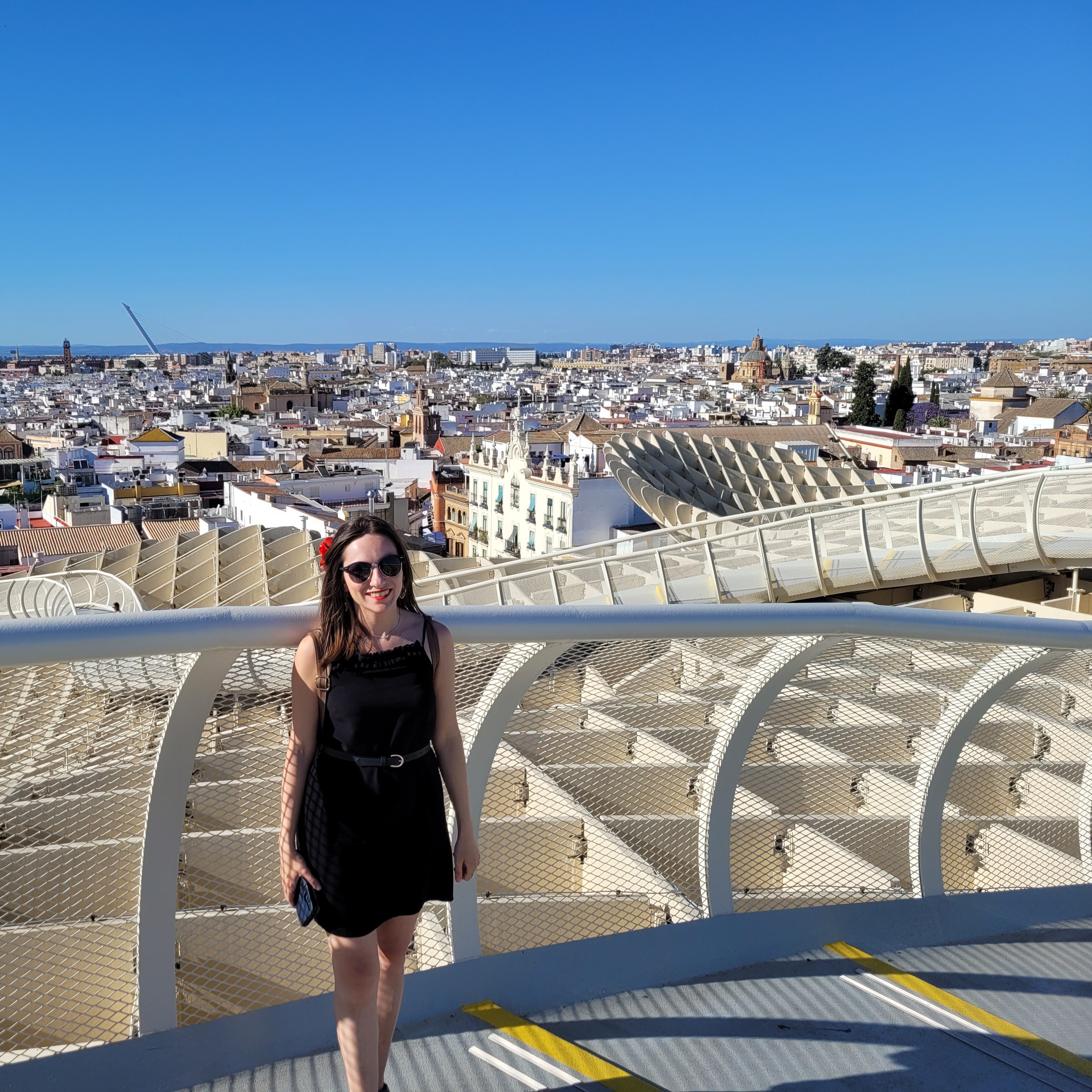
Having filled our day with cultural discoveries, we decided to end our day on a lighter note with the discovery of one of the most emblematic panoramic viewpoint of the city: the Setas de Sevilla.
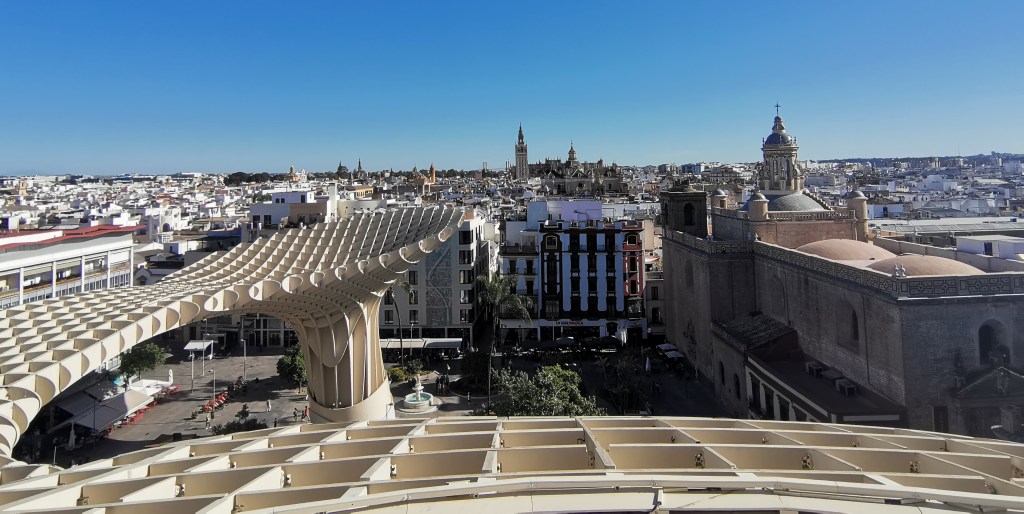
Situated on Plaza de la Encarnación, the Setas de Sevilla is the result of a contest created by the city of Seville for projects to revive this historical square. This contest was won by the German architect Jürgen Mayer. His project offered a new structure for the historical Market of Encarnación and for the Antiquarium (site of Roman remains that can also be visited). It also offered a beautiful viewpoint on the city and provided shade for people to enjoy in the city in summer. Furthermore, the inspiration for the monument were Ficus trees from another square of the city. Originally called Metropol Parasol, it quickly became nicknamed Setas de Sevilla (literally Mushrooms of Seville) due to its shape. The Setas de Sevilla is a modern building as it was only inaugurated in 2021. It is an interesting contrast with all of the historical monuments of the city.
If you wish to go up on the platforms and see the view, the entrance will cost you 15€ per person. If the entrance is a little bit pricey for a 15min movie and a viewpoint, it is still a must-visit site in Seville. It is, after all, a monument you will see in any recent movie or TV series taking place in Seville. From the platforms, you will get a panoramic view on the whole city. You can also set up the audio-guide on your phone which will explain to you briefly the main monuments that you can see from different points of the platform. We visited the Setas by day but we suspect that it is even more impressive at night as the whole structure lights up with different colors then.
DAY 5: ENDING THE TRIP WITH MEMORABLE SIGHTS
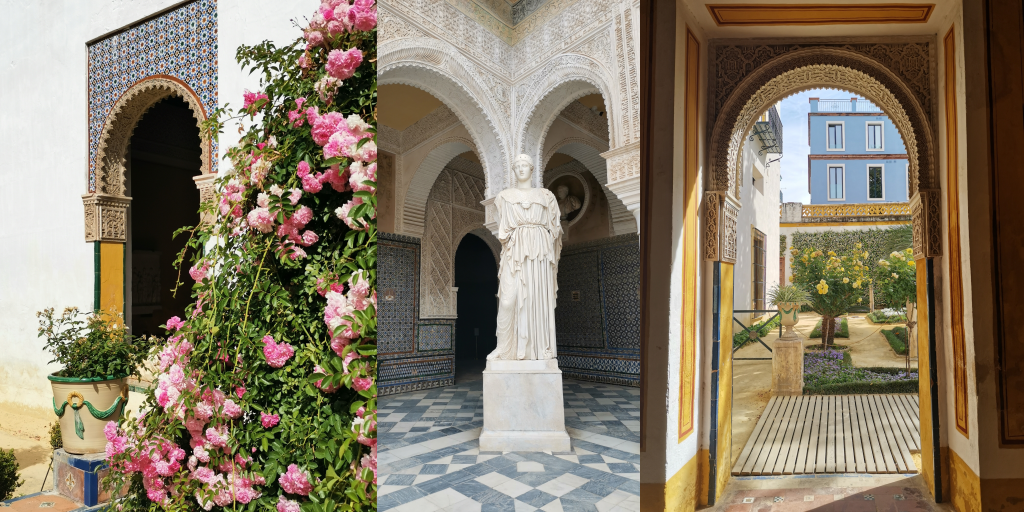
In this photo: Casa de Pilatos
On our last day in Seville, we explored 2 of the top places to visit which the city has to offer. We spent our morning at another palace, the Casa de Pilatos, and spent our afternoon before taking the train on the notorious Plaza de España.
Marvelling at the beauty of House of Pilatos
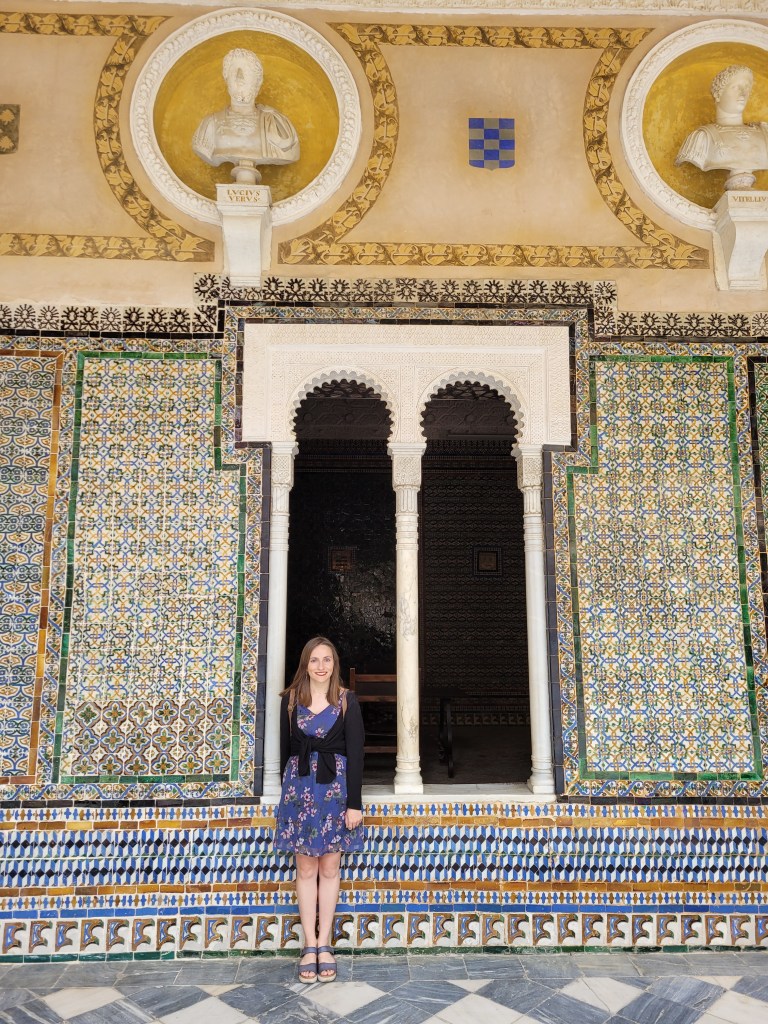
Our morning plan on this Sunday morning was to visit Casa de Pilatos. It is one of the largest private palace in the Andalusian region. Do not miss it! The entrance costs 12€ per person for the individual visit of the bottom floor and 6€ for the guided visit of the upper floor.
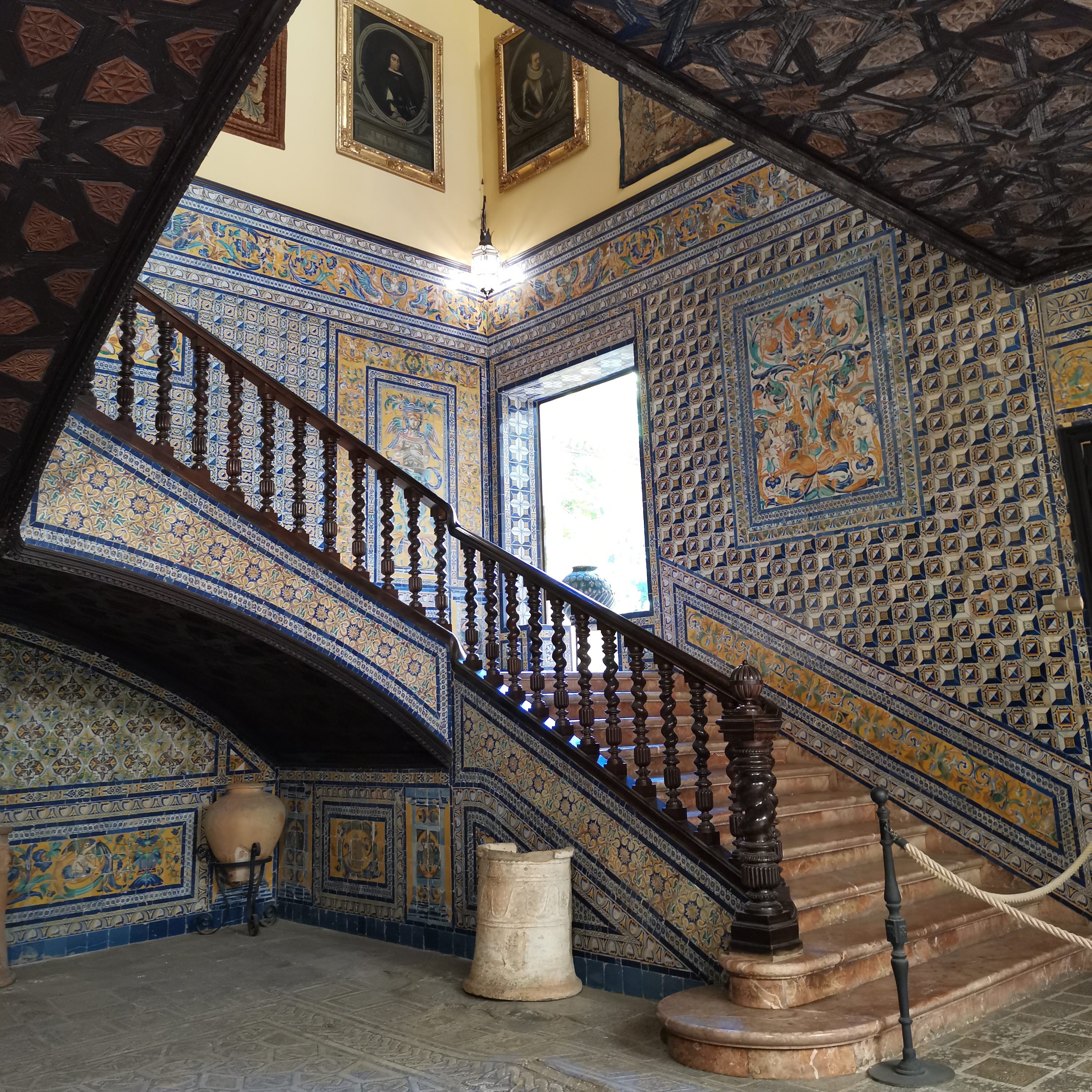
Inside the property, you will see stunning patios, well-flourished gardens, lots of beautiful patios and much more. On the bottom floor, you will visit rooms with walls covered in a great diversity of ceramic tiles. During the guided visit of the upper floor, you will discover elegant rooms. One of them is particularly curious due to the pig-theme in its decoration. It turns out that the latest member of the noble family owning the palace to have lived there was a collector of anything pig-shaped due to her fondness of the animal. Another curious element of the palace is that you will find the family’s coat of arms absolutely everywhere. On the main floor, they appear on the ceramic tiles while, on the top floor, they appear on the large tapestries covering the walls.
During your visit of the bottom floor of the palace, you will be able to listen an audio-guide on your phone. However, the most interesting facts about the palace and how it has been designed will be given to you during the guided visit of the upper floor. There, you will understand why so many of the historical buildings in Seville had ceramic tiles on the walls, for example. It turns out that it was to isolate and keep humidity away, much like tapestries. This is only one of the many fun facts you will learn during the visit.
Discovering all the Spanish provinces at Plaza de España
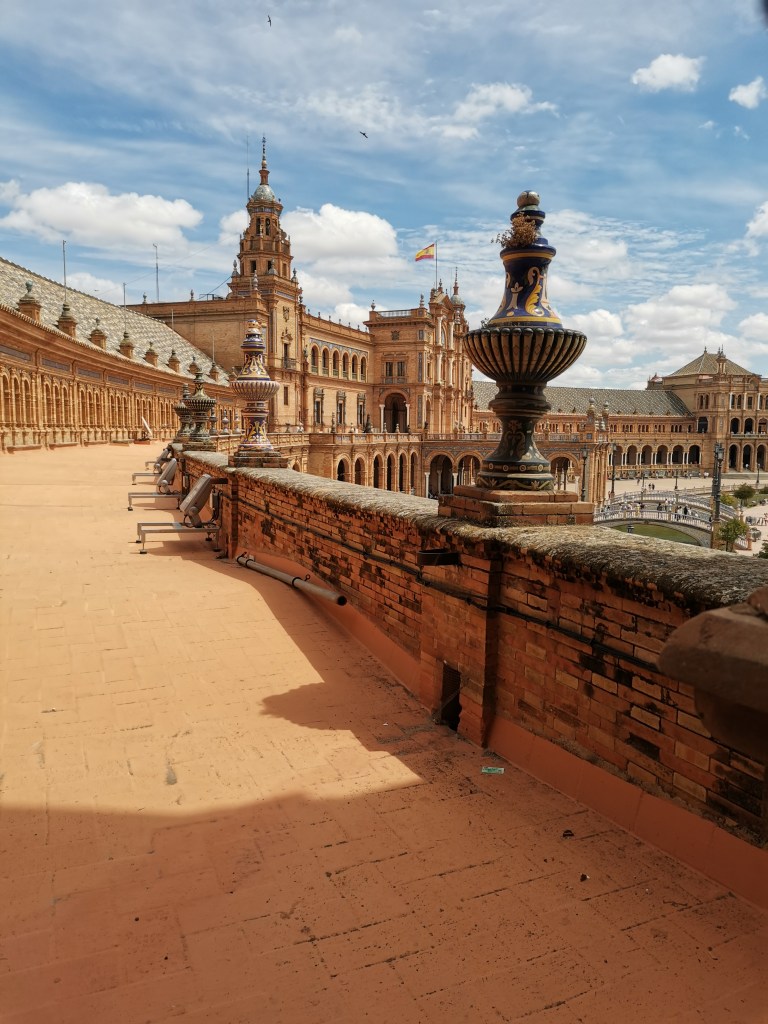
After a good lunch, we headed to Plaza de España before taking our train back. This huge square located right next to Parque María Luisa was built for the 1929 Ibero-American Exhibition, just like the Mudéjar Pavillion which I mentioned before. A huge semi-circular building gives the square its shape and provides a nice viewpoint from its 2nd floor for the visitors. On the stairs leading to this building, you will almost always find a flamenco group playing.
Along the square’s main building, you will find benches entirely decorated of ceramic tiles representing all the provinces of Spain. In the middle of the square, a big fountain stands surrounded by a small channel crossed by 4 bridges also entirely covered of ceramic tiles. On the channel, tourists in small rowboats are enjoying the charming atmosphere of this square.
Following a nice sit on the benches to take the sun, we made our way to the train station to go back home. Seville will stay in our minds as a city full of history and rich of culture. I encourage you to come visit it on your next trip to Spain!
WHERE TO EAT IN SEVILLE?
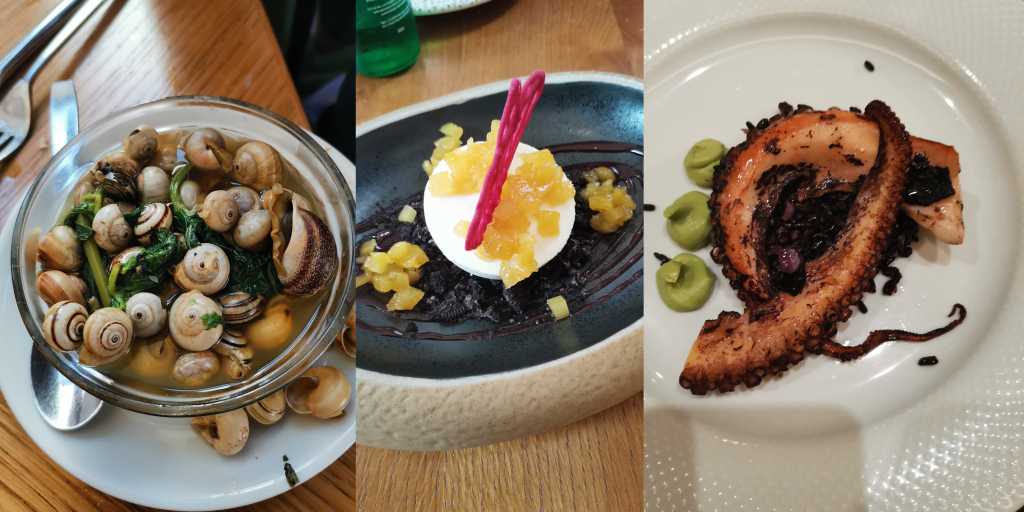
In this photo: Snails at Antigua Casa Diego on the left, Dessert at El Pasaje Santa Maria la Blanca in the middle, Roasted octopus at El Traga on the right
Let me share some of the best addresses which we tried during our stay in Seville.
FOR A SIMPLE LUNCH OF TAPAS…
- Antigua Casa Diego – https://maps.app.goo.gl/6VdgfVzQwPcKvPYW9: Typical Spanish bar well-decorated and highly frequented by locals. Great place to try the local specialty: caracoles (small type of snails cooked in a light broth). Neighborhood: Triana
- Restaurante Doña Rufina – https://maps.app.goo.gl/jMymSHcSKvPaG1jeA: A tapas restaurant with a refined decoration. You will notice that most of the Spanish tapas are fried. If you wish to vary and go for a healthier option, this restaurant makes a delicious plate of Grilled vegetables for 14€ with eggplant, courgettes, peppers and artichoke. Neighborhood: Cathedral
- Pelayo – https://maps.app.goo.gl/vmhtTDoYvmSeutvd8: A very big, typical tapas restaurant. Only downside is that, due to the large number of tables of the restaurant, it can sometimes be hard to get a waiter’s attention. Neighborhood: Cathedral
- Restaurante Al Aljibe – https://maps.app.goo.gl/Rw1crJo4cAhNdNfw5: A restaurant revisiting traditional tapas to turn them into a more gastronomical experience. I truly enjoyed their Rocket & Provolone Risotto (5,3€ for tapas size) and their Gorgonzola & Walnuts Homemade Croquettes (4,4€ for tapas size). This restaurant is located on the very animated Alamada de Hércules square. Neighborhood: Alamada de Hércules
FOR A FANCY DINNER
- El Beso Gastro – https://maps.app.goo.gl/wirqVVmwqPcfMMs26: A restaurant decorated with great taste. We recommend the El Beso salad which features chunks of papaya as well as Iberic ham and parmesan. Neighborhood: Juderia
- El Pasaje Santa Maria la Blanca – https://maps.app.goo.gl/wCXfHfz7UaWyEoYx9: Tapas bars can sometimes get very loud. If you want to find a restaurant with a more quiet and romantic atmosphere, this is the one for you. I recommend the Mushroom risotto (12€). Neighborhood: Close to Casa Fabiola
- El Traga – https://maps.app.goo.gl/3NQxRmc9Mi67NKyLA:This is the most expensive restaurant of the list and it is surely more to reserve for a special occasion. However, the cuisine there is original and exquisite. I highly recommend their Roasted octopus with avocado and black rice (19,8€). I can’t seem to find it anymore on their online menu but I can only encourage you to try their dessert called El Joyero as well. It is essentially a cream with cubes of a fruity jelly on top, all of this placed in a dark chocolate sphere. Neighborhood: Not too far from Casa de Pilatos
FOR A SWEET NOTE
- La Despensa de Palacio – https://maps.app.goo.gl/qLfU19aixNF1C5p69: You must try their sweet called Manzanas del Paraíso (Paradise Apples in English) as it is absolutely delicious. Neighborhood: Not too far from Casa de Pilatos
WHERE TO STAY IN SEVILLE?
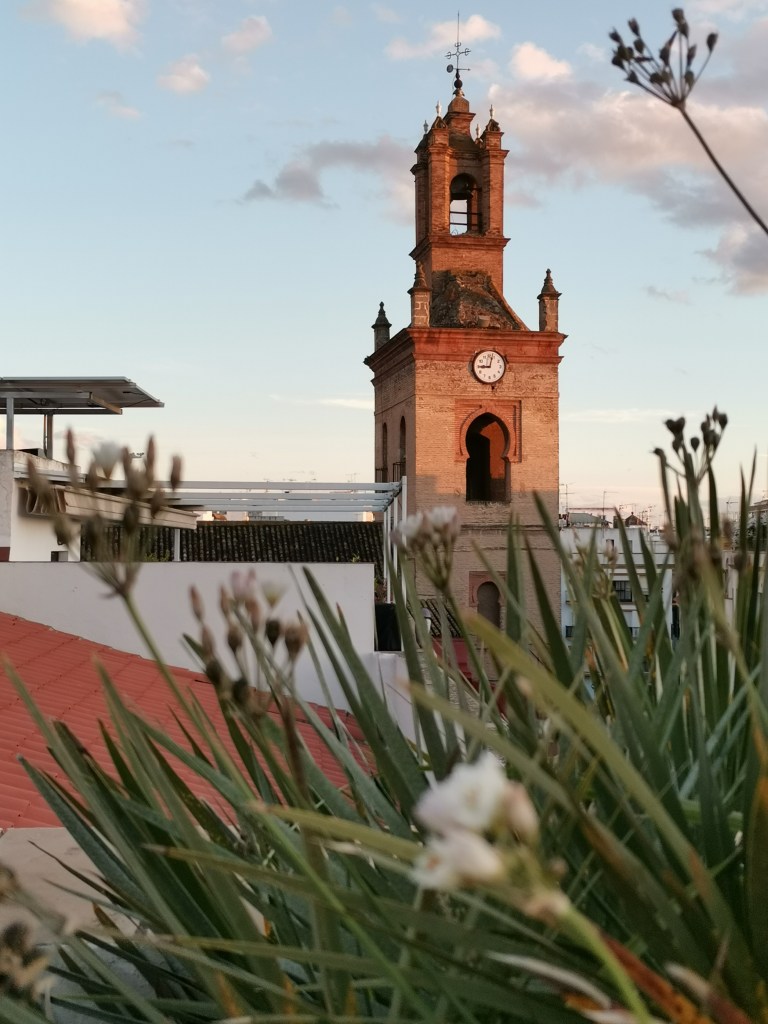
Finding a hotel or place to stay in Seville can be a little bit counter-intuitive. Indeed, you can find great deals in August as it is extremely hot in Seville and Spanish people avoid Seville to look for cooler destinations.
However, spring being the best period to go to Seville, accommodations tend to be more costly during this time of the year. Having gone in May and with more family, we found it cheaper to rent a flat rather than to take an hotel. I also recommend choosing an accommodation in the historical center of Seville if you want to avoid a long commute in the morning and at night to go to and from places.


 She Discovers
Leave a comment