
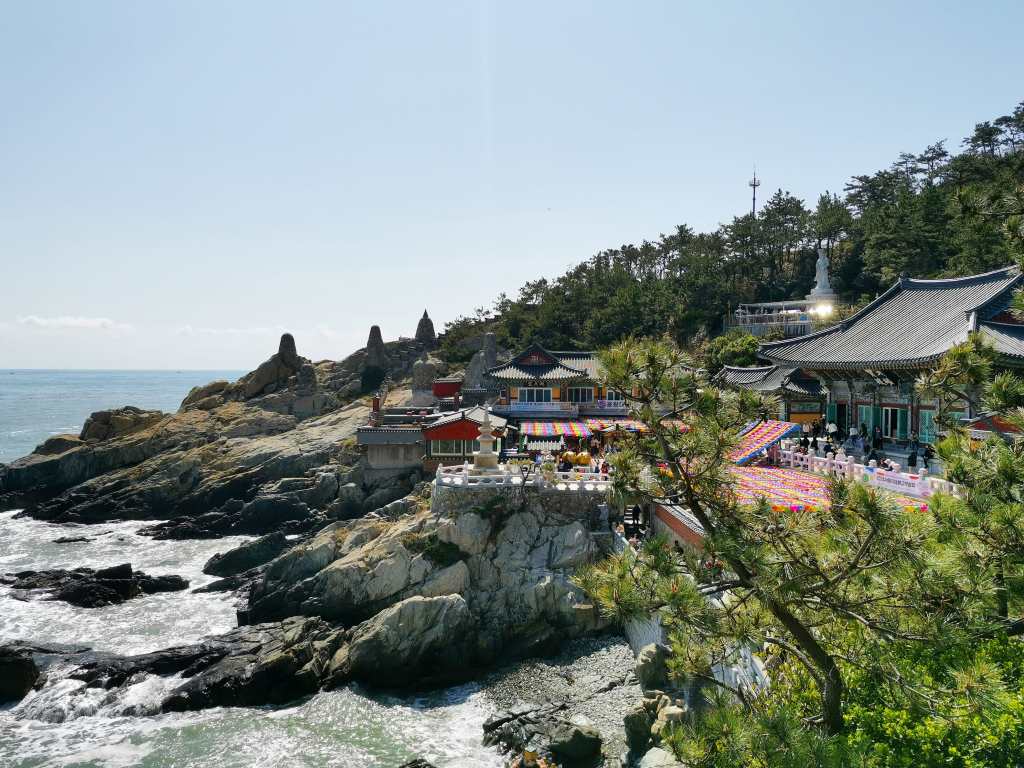
After 6 days in Seoul, my husband and I took the KTX bullet train to arrive at the other end of South Korea, in the coastal city of Busan. Tickets cost 59.800 ₩ each and can be bought on https://www.letskorail.com/. Biggest port and 2nd biggest city in South Korea, Busan has much to offer. You will find many beautiful Buddhist temples, some of the tallest skyscrapers in Korea, great streets for shopping and some nice coastal walks.
OUR ITINERARY
- DAY 1: Yongusan Park + Nampo neighborhood
- DAY 2: Gamcheon Culture Village + Seomyon Young Street + Samgwangsa Temple
- DAY 3: Haedong Yonggungsa Temple + Haeundae Blueline Park + Haeundae Beach + Haeundae Traditional market + Dongbaek island
DAY 1: YONGUSAN PARK + NAMPO NEIGHBORHOOD
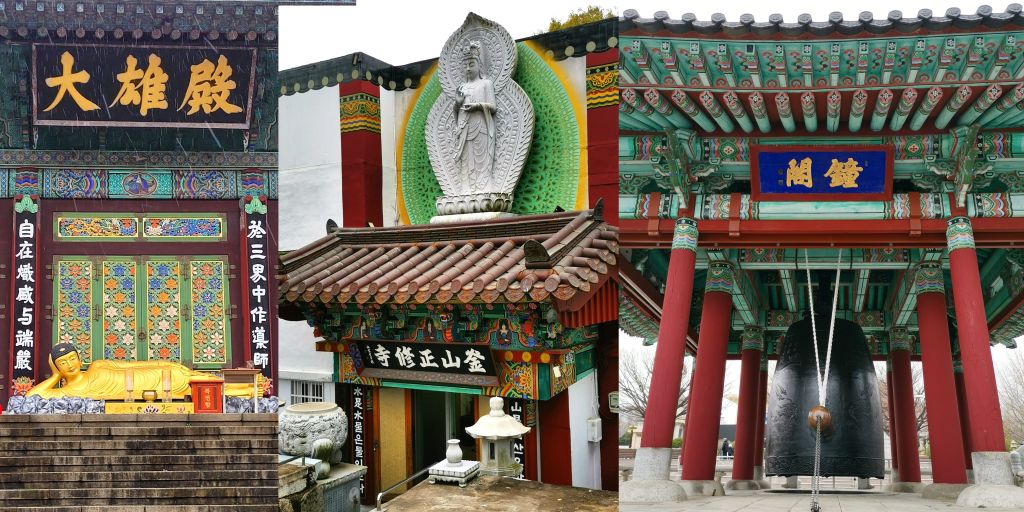
In this photo: Daegaksa Temple (left), Jeongusa Temple (middle), bell pavilion in Yongusan Park (right)
For our first day in Busan, the weather was not great so we decided to stay away from the coast where strong winds were blowing. Instead, we chose to visit one of the busiest neighborhoods of Busan, located near the port. We started our visits by going to Yongusan Park.
What to see in Yongusan Park?
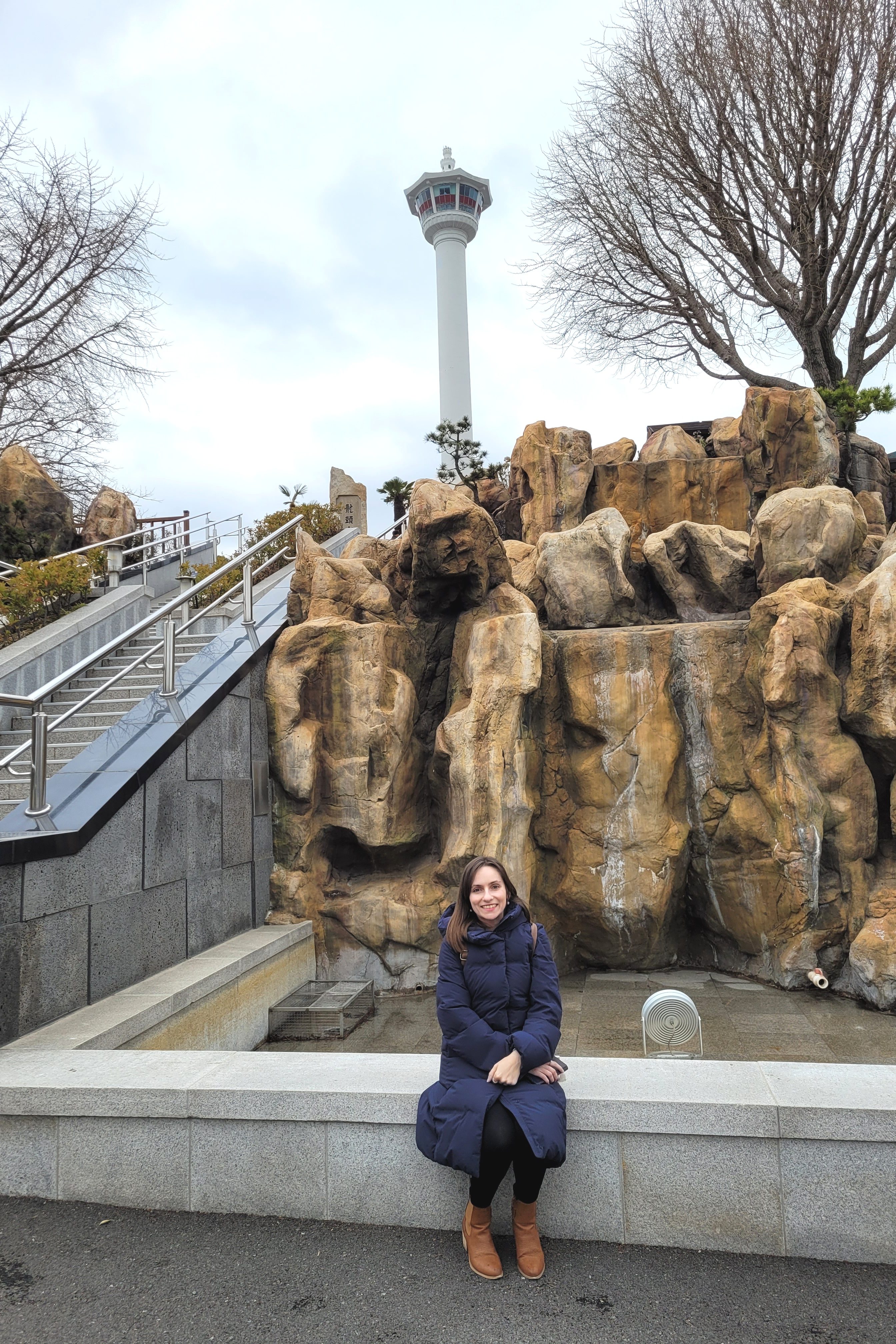
Yongusan park is a must-do in Busan as it is home to the Busan Tower where you can get a beautiful view on the whole coastal city. Due to bad weather, we did not go up the tower. However, Yongusan Park being on a hill, you already get a very nice view at the bottom of the tower. If you are looking for pretty postcards or posters of Busan to get as souvenirs, I advise you to go check the souvenir shops around the tower which have some nice items.
In Yongusan Park, you will also find an outdoor exhibit on the different types of traditional walls in Korean architecture, an impressive bell pavilion and Jeongusa temple. It is overall a great place to start your visit of Busan with beautiful views and some cultural spots.
Shopping on Gwangbok-ro Fashion Street
Going downhill from Yongusan Park, we arrived at Gwangbok-ro Fashion Street. This street is the main commercial avenue in the Nampo neighborhood. As a result, it is the perfect place to go shopping in the city.
One shop I particularly liked for affordable clothing is Bimil shop – https://naver.me/GEIWGqsQ. I am sharing with you the address on Naver Maps as I was not able to find it on Google Maps.
What else to do around Nampo?
After having bought a few pieces of clothing, we headed to go see Daegaksa Temple with its pretty statue of the reclining buddha. Continuing our tour of the neighborhood, we then went to Bosu Book street, a narrow alley with lots of small bookstores. Further down the route, we visited Gukje Market, a traditional market where you find a little bit of everything, from everyday cutlery to chandeliers. Within the market, the highlight for me was a shop with lots of lacquer boxes, lacquer trays and lacquer furniture. After this visit, we walked in the direction of the coast to reach Jagalchi market next to the port.
Jagalchi market is a very impressive place. It is a huge fish market where you can buy fish still alive and then go eat it fresh and raw on the 2nd floor of the building. Eating fish and seafood raw is a specialty in the Busan region. I recommend you go check out this market as I personally had never seen anything like it before and you might not have either.
After the market, we headed to the Lotte Department Store Gwangbok to see the view from its rooftop terrace. I recommend to go there at night as the view is spectacular with the bridges lit up with colorful lights.
Where to eat in Nampo?
- Song Song Noodle House – https://maps.app.goo.gl/uoDFVsiBCeXZyDb87 – A delicious Korean noodle place. You will be given a hot pot with the ingredients of the dish you chose and a set of instructions is pinned on the wall so you can prepare and eat your meal the right way. Each table is equipped with an electric hot plaque to heat your food. I ate Chicken soup with noodle for 7.500 ₩;
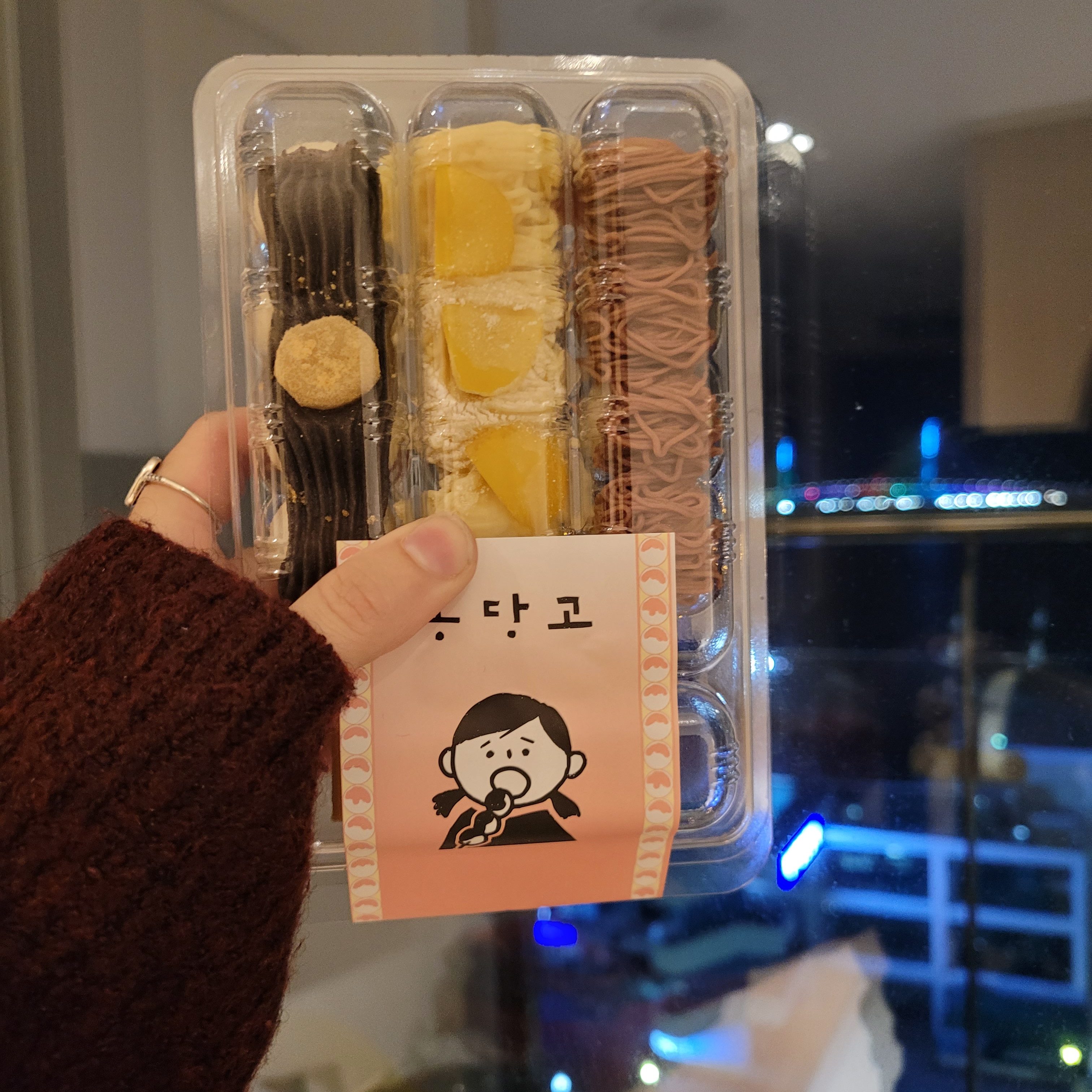
- Food court of Lotte Department Store – You will find the food court in the middle of floor B1. There are so many different types of food to try there. From bibimbap places to sushi bars or dumpling places, you will necessarily find something you like. I even got to try Japanese dangos (rice balls which can be sweet or salty depending on the sauces added) for the first time there.
DAY 2: GAMCHEON CULTURE VILLAGE + SEOMYON YOUNG STREET + SAMGWANGSA TEMPLE
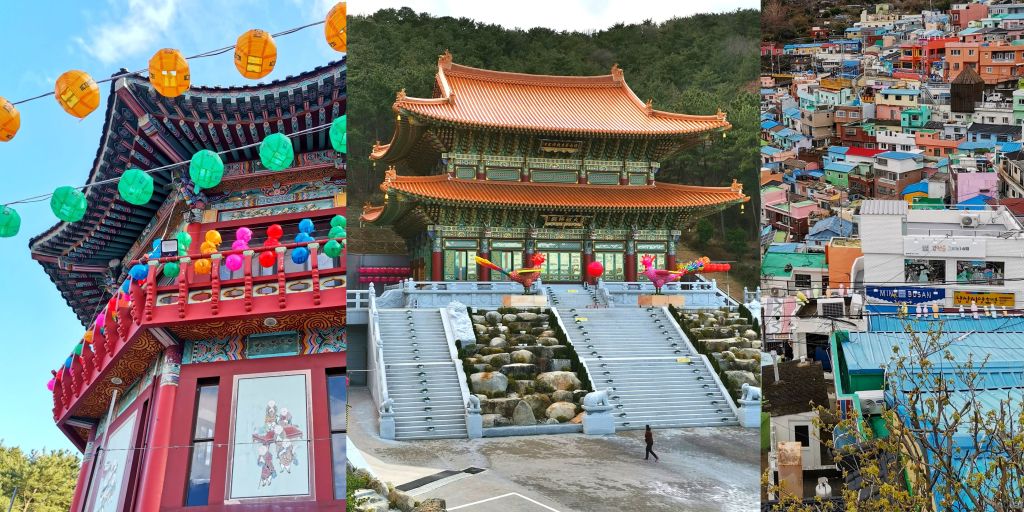
In this picture: Samgwangsa Temple (left & middle) and Gamcheon Culture Village (right)
For our 2nd day in Busan, we decided to go a little bit further from the port and discover other neighborhoods of the city. As we were told that Busan was also famous for its numerous Buddhist temples, we also chose to add to the program one of the most impressive one in the region: Samgwangsa Temple.
Starting the day at Gamcheon Culture Village
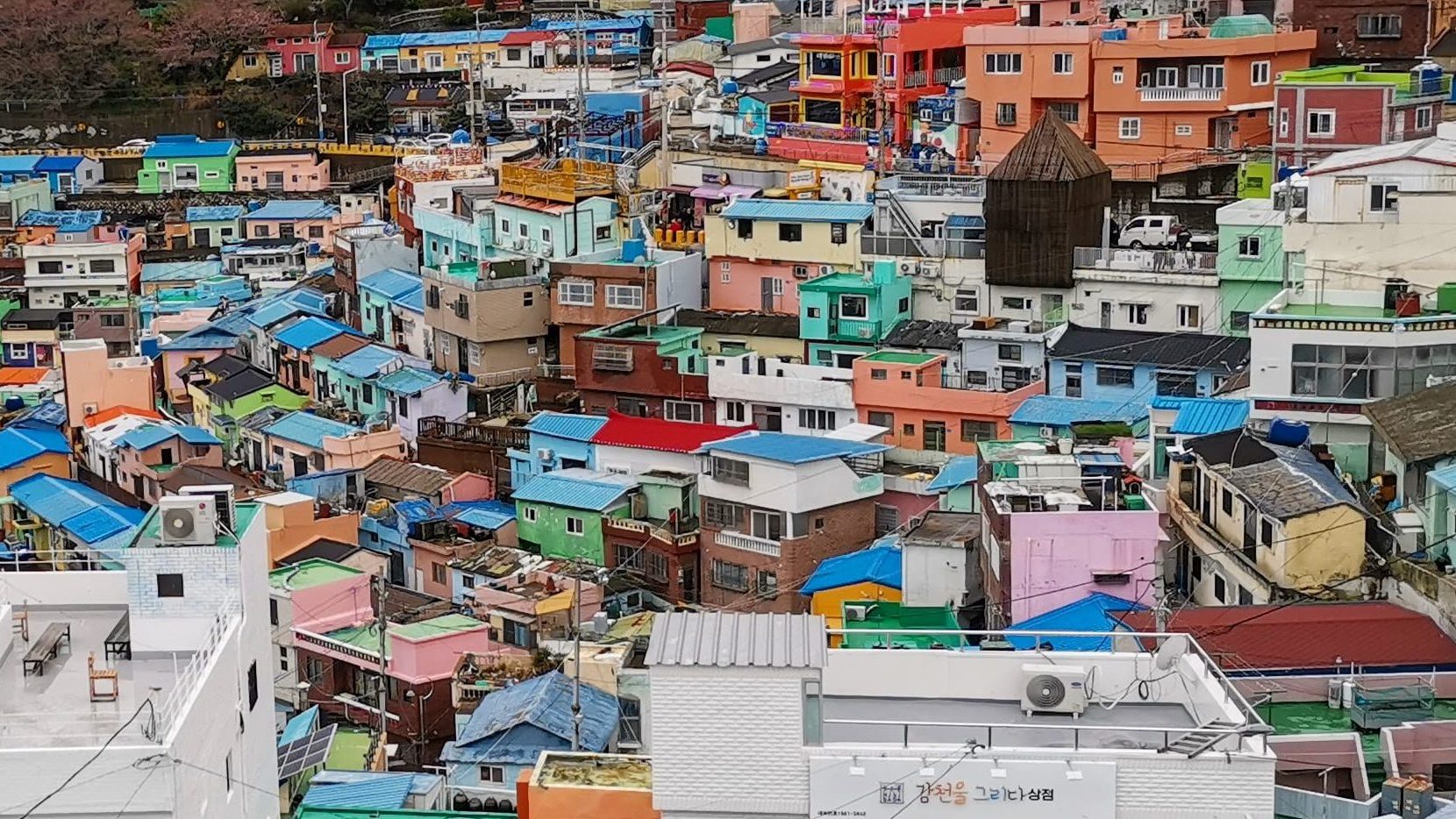
Gamcheon Culture Village comes out of an urbanistic project that won many awards, including internationally. This neighborhood dating back from the 20s was created to house working-class families, often working for the nearby port. However, the neighborhood was quite poor and the living standards low. This is where enters a governmental initiative in 2009 to give a new life to this neighborhood. They painted the houses in all the colors of the rainbow and called artists to fill the neighborhood with varied works of art. The goal? Transform the neighborhood in a cultural place-to-visit and bring tourism to it.
This initiative has been a clear success and you will see many other similar initiatives all across Korea of neighborhoods that have been made touristic and lively again by making them picture-worthy thanks to the help of many artists. Ihwa Mural Village, which I mentioned in my previous post on my stay in Seoul, is another example of such projects.
Going back to Gamcheon Culture Village, the neighborhood is located on a hill. Upon your arrival, you will see a map with a suggested path to see all the best sights and art pieces. I suggest you follow this path before going to explore smaller streets so you do not miss the highlights of this neighborhood. Along the main path, you will find many souvenir shops and cafés.
While in Gamcheon Culture Village, there are two places I particularly recommend you see. The first one, located at the entrance of the village is the Little Museum – https://maps.app.goo.gl/i9EojVTCQXJq27ZBA. It is free to visit and it will explain to you the whole history of the neighborhood and how this urbanistic project came to life to turn Gamcheon into a key cultural attraction of Busan. The second place to see is the Haneul Maru terrace (photo above) – https://maps.app.goo.gl/s4wnZRiu1K81xEPz5 – where you will have the best view on the full village. Due to its colorful houses on a hill, Koreans like to call Gamcheon Culture Village the Macchu Pichu or the Santorini of Korea. To be truthful, although it is hard to compare, it reminded me more of Procida island in Italy, also known for its colorful houses.
Where to eat in Gamcheon Culture Village?
After visiting Gamcheon Culture Village, we stayed an hour more in this neighborhood to enjoy a nice lunch in one of the many restaurants. I recommend vividly the restaurant we went to, away from the main touristic path. Called Gamcheon Sagol Gomtang – https://maps.app.goo.gl/aNLH7ghGVGMSQLtm9, I encourage you to try the restaurant’s specialty: the dumpling beef soup (8.000 ₩). The restaurant staff greeted us very warmly and even gave us a specialty drink at the end to thank us. If you do not believe me that this restaurant is the one to try, let its 5-star average rating on Google maps convince you.
On our way to Seomyon Young Street
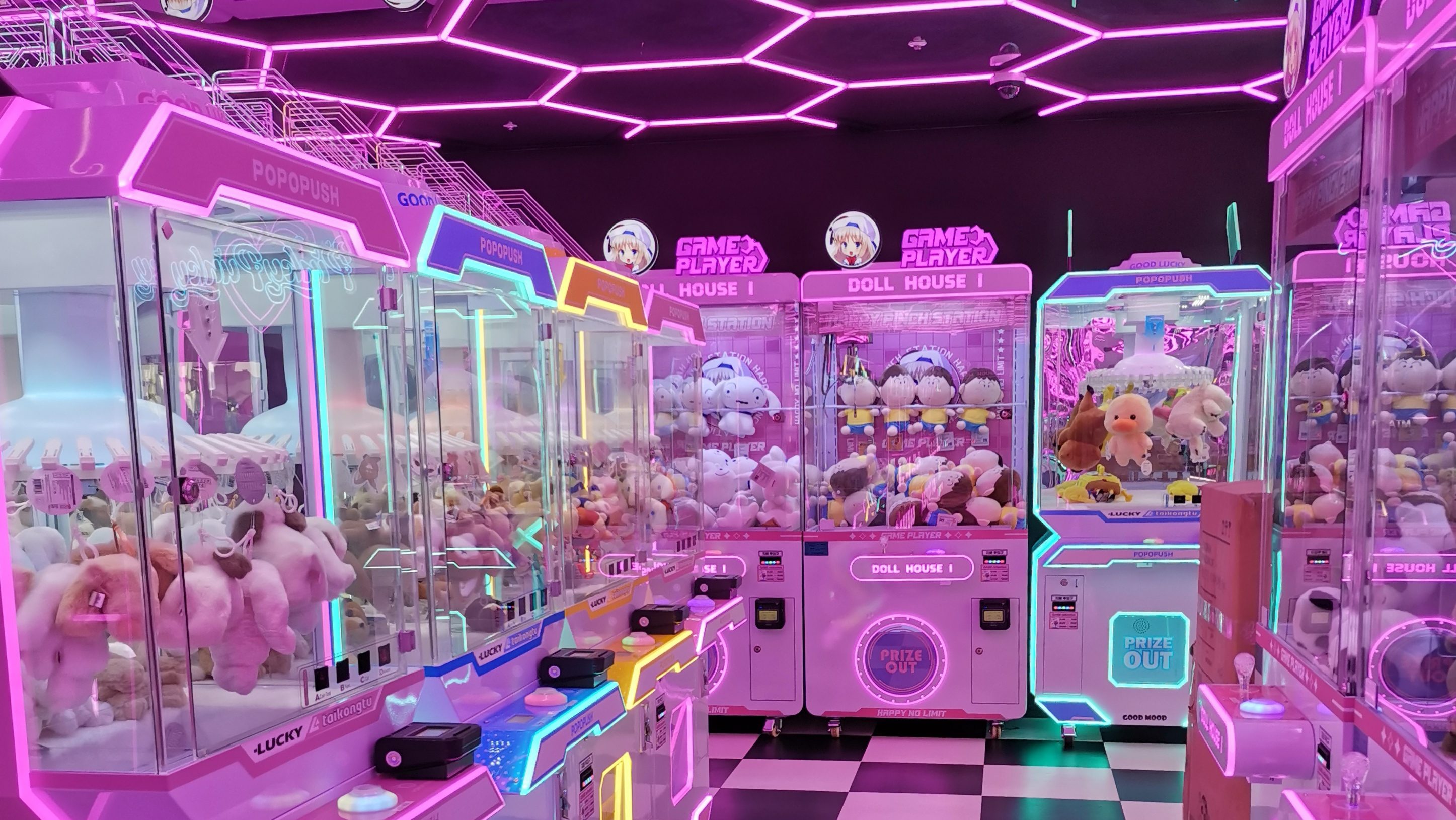
Following our delicious lunch, we walked down the hill by foot to find more options of public transportation in order to reach Seomyon Young Street. Seomyon is another one of the busiest neighborhoods of Busan, alongside Nampo. One of the main attractions of this part of town is Seomyon Young Street. This street is basically where you would go if you were young and were to plan a first date with someone or for a fun day out with friends.
In that street alone, you find many arcade places with all sorts of games and claw machines. Visiting some of those, we stumbled upon what was probably the most talented Dance Dance Revolution player we will have ever seen. We also played a fun game similar to Guitar Hero but with drums. You will also find in this street a bowling alley, some cafés and many selfie photo booths. If you do not know what are selfie photo booths, these are locals where you can borrow many cute accessories and then go in photo booths to take fun pictures with your friends or boyfriend / girlfriend. You will find them absolutely everywhere in Korea.
All the way up to Samgwangsa Temple
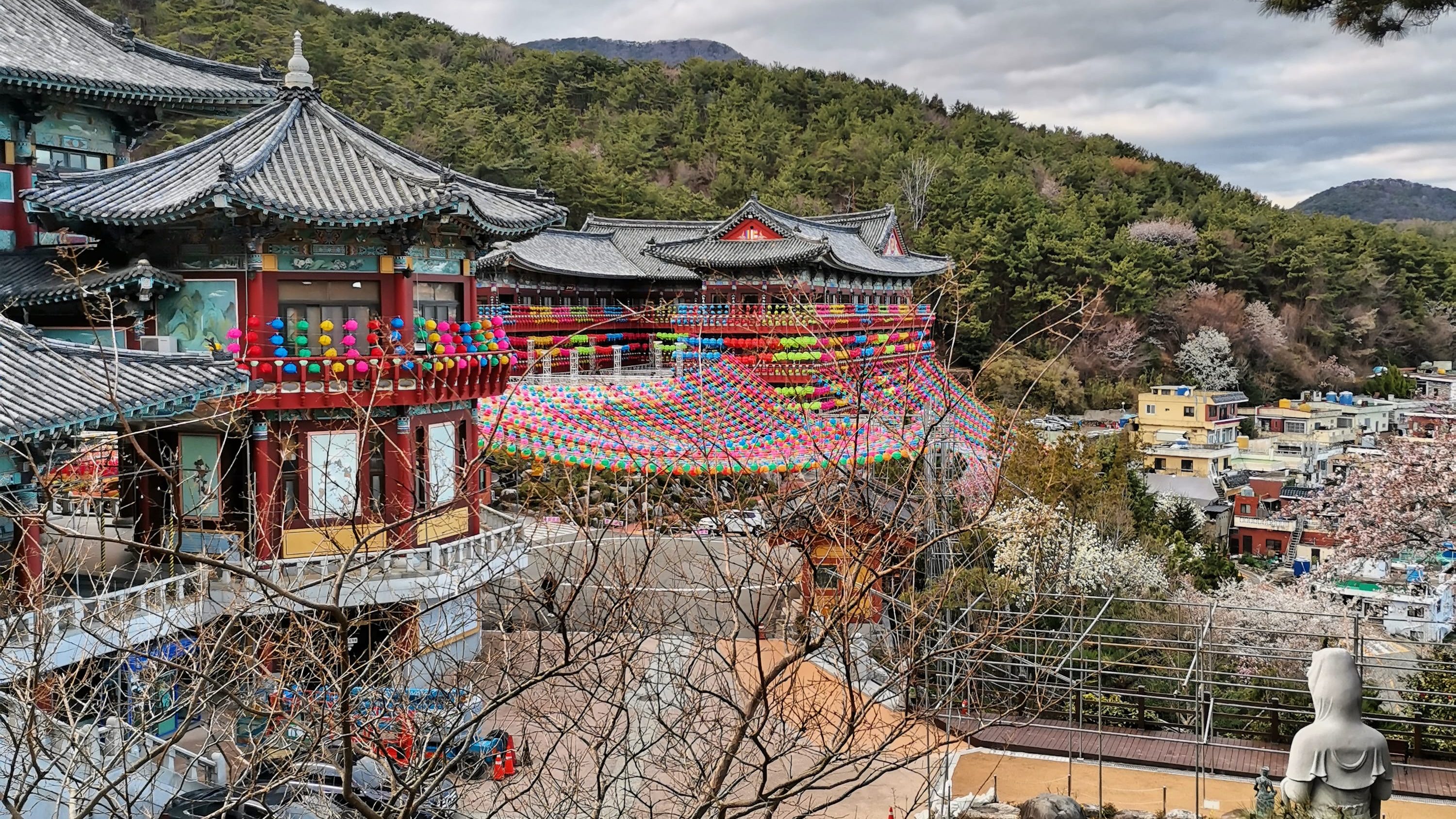
After exploring the trendy young street of Seomyon, we took a bus to reach a more peaceful destination: Samgwangsa Temple (photo above). You will probably read online that Samgwangsa Temple is a place worth visiting especially during the Lotus Lantern Festival organized each year for Buddha’s Birthday in May. Despite not going during the festival, the temple looked absolutely beautiful and I would recommend visiting it to anyone. On the temple’s premises reigned an extremely tranquil atmosphere.
Samgwangsa Temple is located on a hill as most Buddhist temples. It is impressive in 3 aspects: its size (lots of different buildings and areas to see), the beauty and variety of its ornaments (statues, paintings,…) and the peacefulness of its premises that creates a very solemn atmosphere.
Make sure you do not get to the temple too late in the afternoon. Despite the temple being open all day long, many buildings of the temple close at 5 or 6pm.
DAY 3: HAEDONG YONGGUNGSA TEMPLE + HAEUNDAE BEACH + DONGBAEK ISLAND
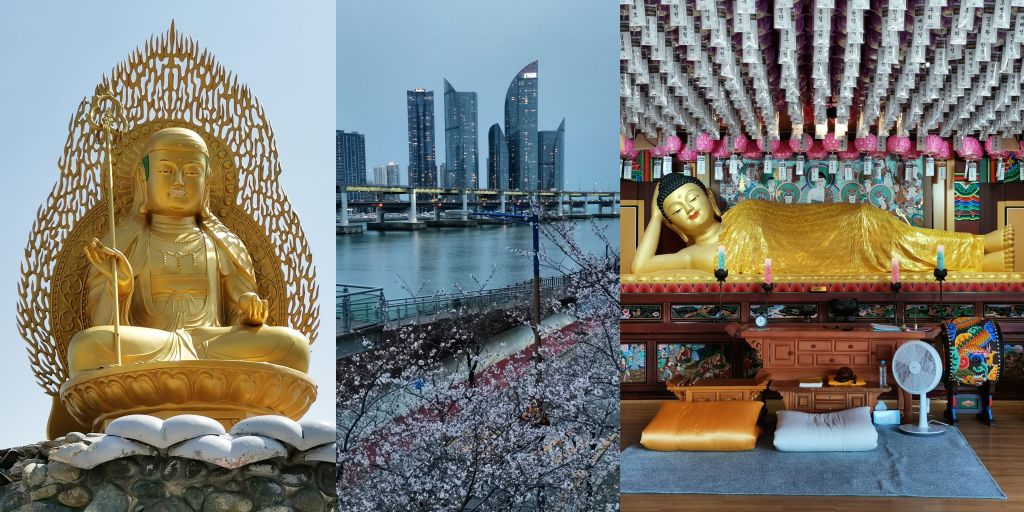
In this picture: Haedong Yonggungsa Temple (left and right) and Haeundae neighborhood (middle)
Waking up on our last day in Busan, the weather had significantly improved and it was even sunny. We thus agreed to go explore the coast of Busan.
Discovering Haedong Yonggungsa Temple
Our day of adventures started at Haedong Yonggungsa Temple (see this post’s main picture at the top of the page), one of the only Buddhist temples you will find by the sea. Thanks to its prime location and its splendid views on the coast, Haedong Yonggungsa temple has also become a top place to visit for tourists while in Busan. As a result, you will certainly not be the only one to have come to see this wonderful place.
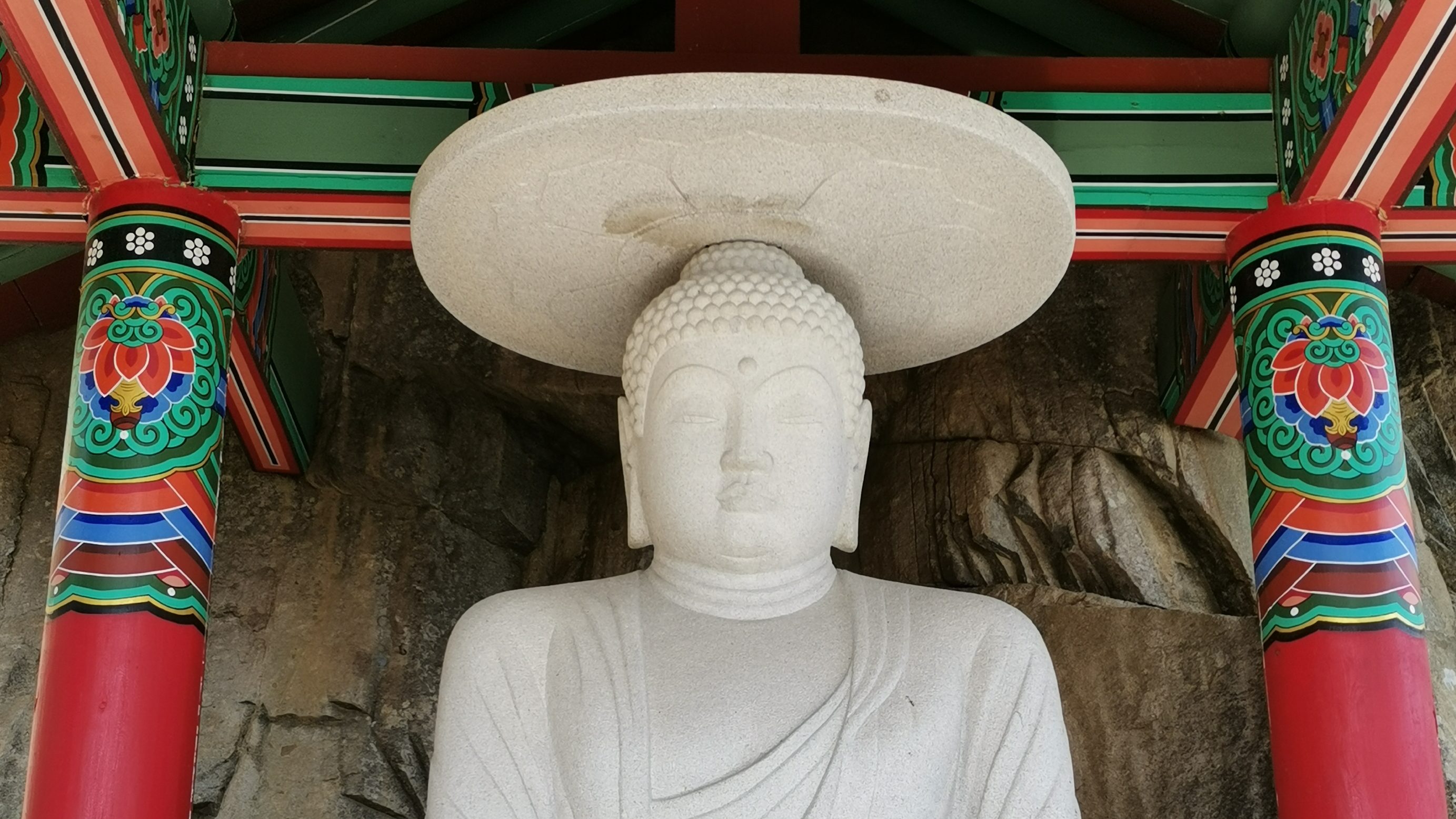
Inside the temple, you will see statues of the Chinese Zodiac signs, a stone pagoda, beautiful gold statues of Buddha (photos above) and much more!
Where to eat around Haedong Yonggungsa Temple?
After our visit of the temple, we decided to go down to the coast and walk a little bit to find a less touristic zone with more local restaurants. We really wanted to try some local seafood for our last day in this coastal town. We ended up at Choeseonjang – https://maps.app.goo.gl/BnXH1bmWyPpaBe638, a seafood restaurant right next to the sea. We saw that all the clients were locals and that the menu was not translated to English and concluded it was a perfect restaurant to try local seafood dishes. I tried abalone pot rice for 15.000 ₩ which was very good. My husband tried a raw fish dish. Both menus came with lots of side dishes, also delicious. We were thankful for the nice restaurant owner who taught us how to assemble the various elements of our dishes to eat our meals in the proper way.
If you want a great seafood experience in Busan, you now know where to go!
On our way to Haeundae
Having replenished our stomachs, we continued our journey following the coast up to the start of the Haeundae Blueline Park on Songjeong Beach. Busan seems a big surfing destination as we saw lots of surf schools around Songjeong Beach and many surfers at sea, trying to catch the best waves.
At the Songjeong station of Haeundae Blueline Park, we took our tickets for the colorful beach train (7.000 ₩ per person). This beach train goes up to Mipo station, located at the start of Haeundae beach, the most famous beach in Busan. You can also, for a higher fee, change midway to individual sky capsules for the 2nd half of the trip. Seeing how the weather had become cloudy, we stayed on the beach train and enjoyed it a lot. The trip from Songjeon beach to Mipo (Haeundae beach) takes about 30 minutes and explanations on the various sights you pass by are given in English during the ride. The beach train itself has been designed to look like old European tramways.
One of the most impressive part of the ride is that you can see in the distance the silhouette of Japanese islands, located only 40 km away.
What to do once in the Haeundae district?
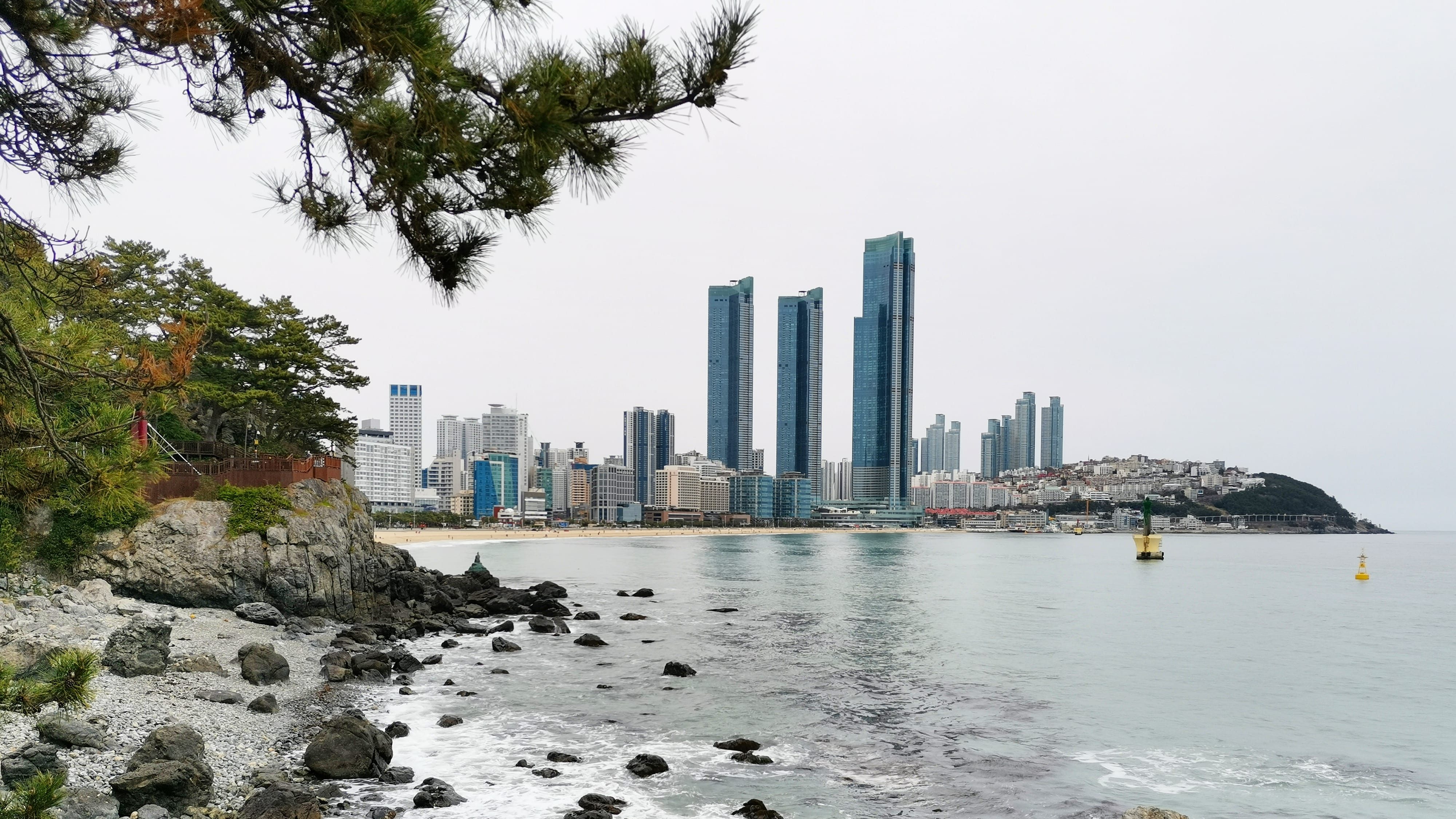
Once at Mipo station, we encourage you to go visit Haeundae beach. You will see there many skyscrapers, including the one housing the observatory Busan x the Sky if you want to see a panoramic view of Busan. Due to the cloudy weather, we preferred not to go up and to continue our walk along the beach. Next to the tower where is located Busan x the Sky, you will see an even taller skyscraper: it is the 2nd biggest one in South Korea, just behind Lotte World Tower in Seoul.
Once you arrive at around the midway point of the beach, you will see a round circular place and a big avenue, called Gunam-ro. Take a small detour by following this avenue and taking the 1st right: it will lead you to Haeundae Traditional Market. In this market, you will find numerous street food stands and some shops. I particularly enjoyed one of the shop selling typical Korean tableware.
After having explored the market, go back in direction of the beach and finish your stroll along the beach until the end. You will get to stairs leading inside a public park following the coastline. You have then arrived at Dongbaek island’s coastal promenade.
Why visit Dongbaek island?
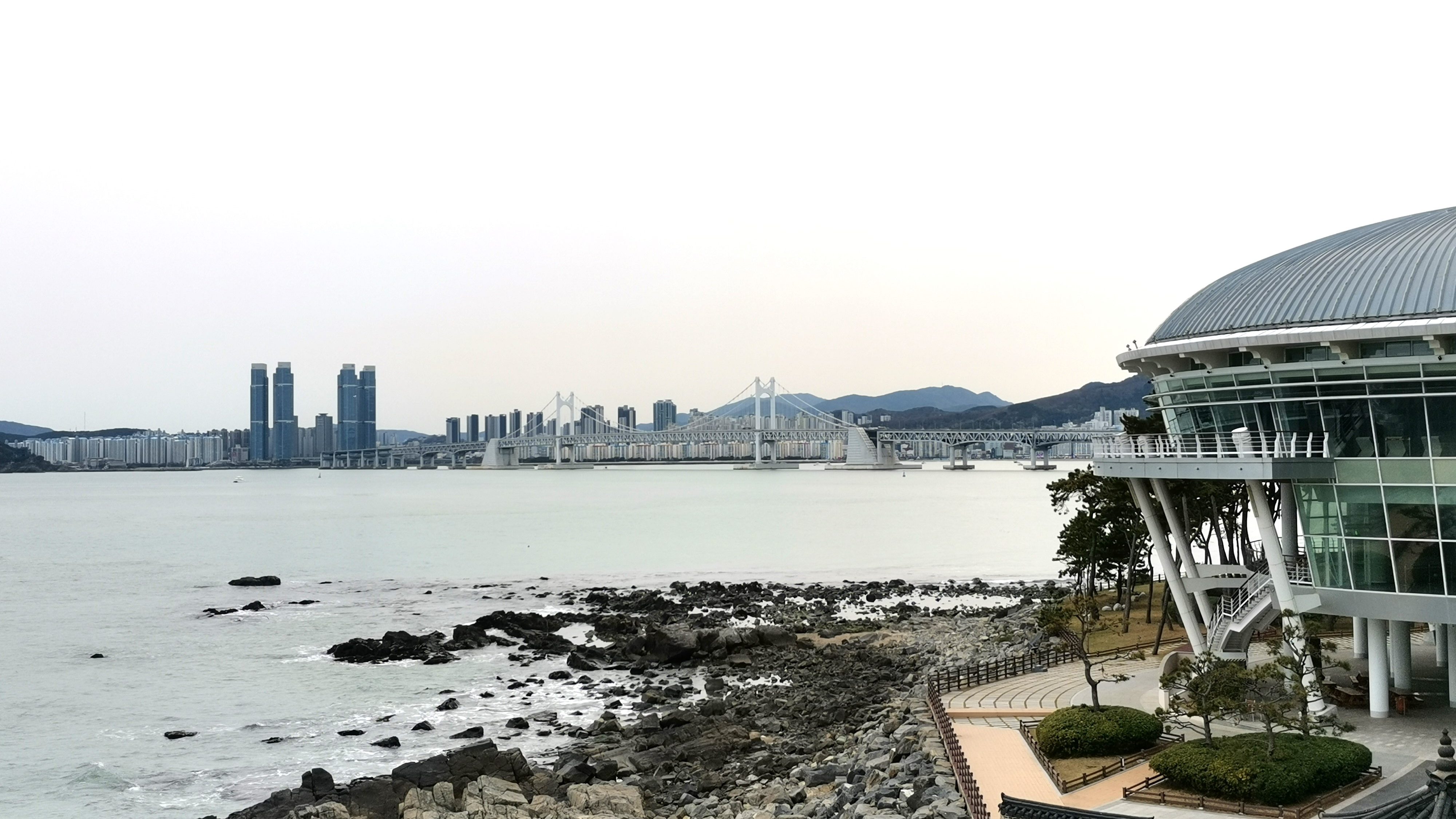
Dongbaek island has been one of the highlights of our trip to Busan. While walking on the coastal promenade on the island, we saw the most beautiful views of Haeundae beach and, on the other side, of Gwangan bridge (which reminded me a lot of Brooklyn Bridge in NYC). At Dongbaekseom Lighthouse, there were also some binoculars that allowed us to look at the Oryukdo islets in the distance. If you want to have a romantic stroll along the coast, Dongbaek island is your place to go!
WHERE TO STAY IN BUSAN?
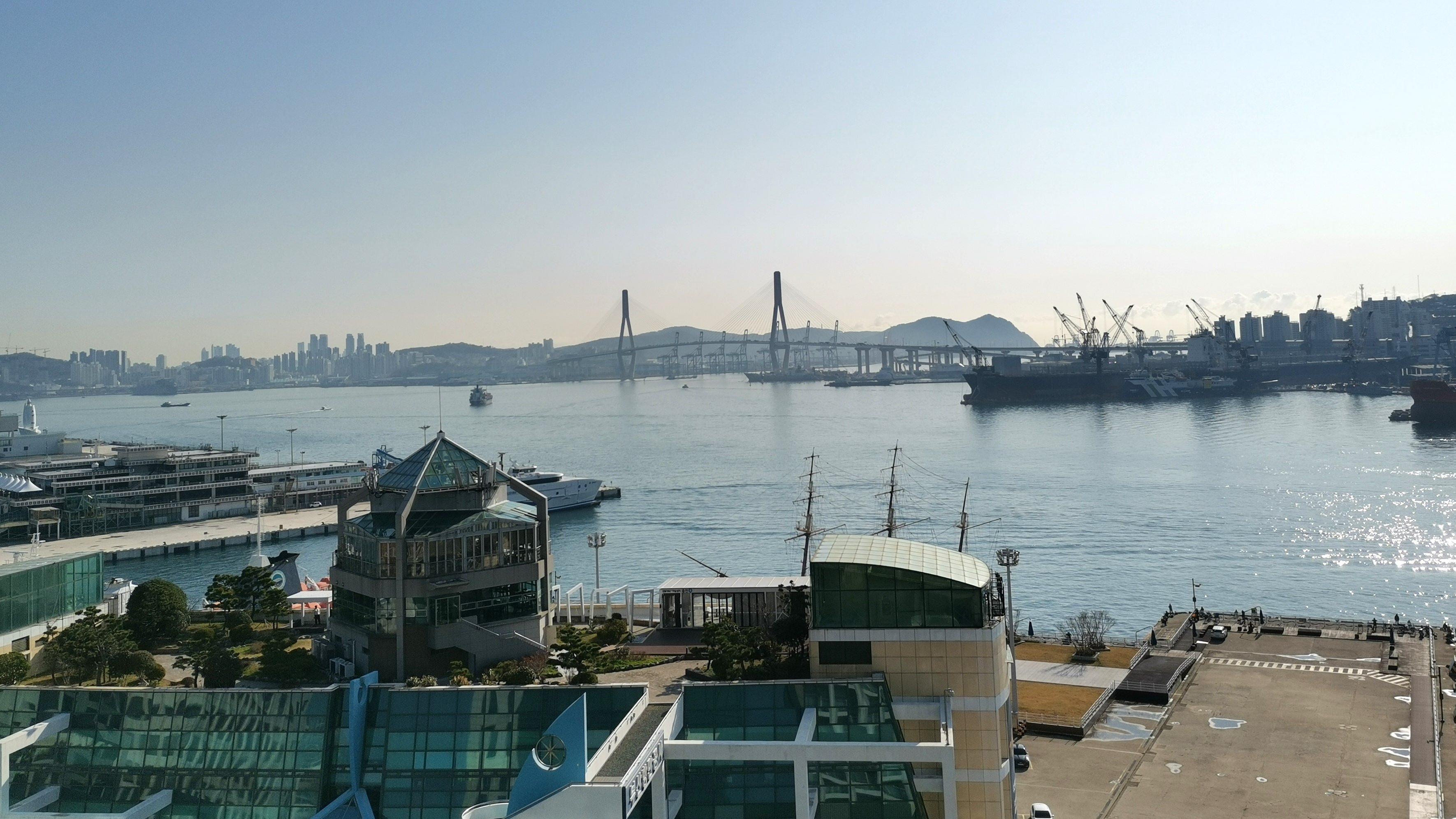
We chose a hotel near the port, mainly due to its closeness to the train station. Indeed, after our 3rd night in Busan, we would have an early train to catch to go back to Seoul. We were very happy with our hotel, Busan Connect Ocean Hotel – https://maps.app.goo.gl/fKUp64VkEbRVtdvW8.
For about 40 euros a night, our room had a terrace and a beautiful view on the sea and on Busan Harbor Bridge. The view was spectacular at night as the bridge lit up with all the different colors of the rainbow. For dinner, we often chose to buy food at the Lotte Department Store food court and to eat it at the hotel facing this great view. Another strong point of the hotel was that it comprised a self-service kitchen with microwaves to re-heat food.
HOW TO GO AROUND BUSAN?
As the 2nd biggest city in South Korea, it is almost impossible to visit the whole of Busan by foot due to lack of time. The public transportation system is, however, excellent (numerous buses and metro lines). You can use public transport by buying single journey tickets (cash only) at metro stations or by using your T-money card. You can buy this personal card for 5.000 ₩ and you can recharge it with cash at 7-eleven stores with the amount of money you need.

 She Discovers
Leave a comment